
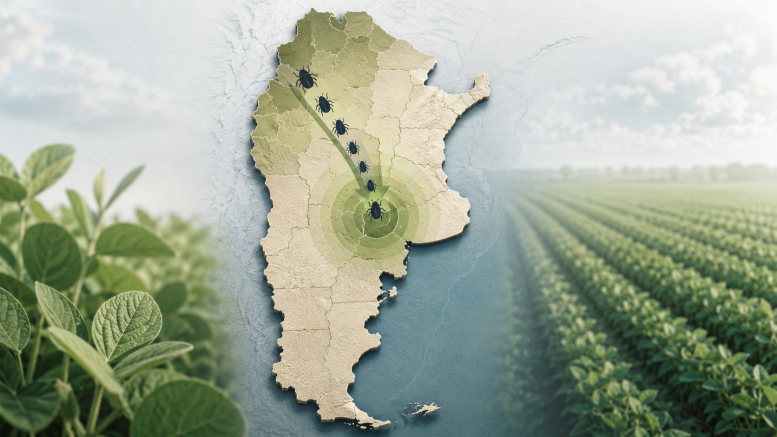
The Soybean Black Weevil Has Spread Into Central Argentina
Brazil
The Ministry of Agriculture announced the approval of 44 technical pesticide registrations. Tatiane Almeida do Nascimento, coordinator of pesticide and bioinput registrations, was authorized to travel abroad to participate in the “International Workshop on Regulatory Advances in Gene Editing in the Americas,” held in Medellín, Colombia, from May 11th to 17th. (Official Gazette of Brazil, Act No. 29 and Orders published on 05/11/26, MAPA)
Brazil’s Federal Government launched a dashboard to monitor the presence of crop protection products in water resources, developed by the Ministry of Environment and Climate Change under the National Program for the Reduction of Pesticides, based on data from Embrapa. The tool brings together information on sampling points, monitored substances and detection frequency in river basins. According to initial data, more than 10 thousand analyses were carried out, with detection in 7.2% of cases, covering 49 crop protection products. Available at: https://tinyurl.com/yeysmuze. (Brazil’s Federal Government; MMA)
During BioSummit 2026, CropLife Brasil reported that Brazil’s bioinputs market reached US$ 1.27 billion in 2025 and covered 194 million treated hectares, stating that the challenge is to turn Brazil’s comparative advantage into global leadership. The Brazilian Association of Bioinput Industries called for urgent infralegal regulation of the new Bioinputs Law, stating that the lack of definitions is already affecting registrations, inspections and production routines. In addition, DunhamTrimmer projects 10% global growth for the sector through 2030; and Wagner Bettiol, from Embrapa Environment, estimates that biological control could reach 50% of Brazil’s crop protection market by 2050. (BioSummit; CropLife Brasil; Abinbio; DunhamTrimmer)
Anvisa approved, in compliance with a court decision, the toxicological evaluation of technical pyriproxyfen from Rainbow. (Official Gazette of Brazil, Resolution No. 1907 – published on 05/11/26, Anvisa)
Nutrien reported net earnings of US$ 139 million in the 1Q26, more than seven times the US$ 19 million recorded in the same period of 2025, with revenue reaching US$ 6 billion. The result was driven by potash, whose division reached a sales record of 3.5 million tonnes. The company highlighted strong demand in Brazil, the USA and India, as well as the need to replenish soil nutrients after Brazil’s record 2025 harvest. Despite the operational improvement, stock prices decreased by more than 7% after results missed analysts’ expectations. (Nutrien)
The Ministry of Agriculture updated the official table of soybean disease targets, standardizing scientific and common names. The list includes diseases such as soybean Asian rust, white mold, anthracnose, powdery mildew, downy mildew, target spot, root rots, nematodes and other occurrences associated with the crop. The measure updates Normative Instruction No. 42/2002. (Official Gazette of Brazil, Act No. 28 – published on 05/08/26, MAPA)
StoneX reported the global urea market began to lose momentum after two months of strong price increases, with declines in Brazil, the USA, China, the Middle East and Egypt. In Brazil, urea prices posted a second consecutive weekly drop, with prices below US$ 770 per tonne, about 4% lower than references two weeks earlier. According to analyst Tomás Pernías, weaker demand has gained more weight in price formation, although logistical bottlenecks in the Middle East still limit sharper short-term declines. (StoneX Consulting)
The National Union of the Plant Protection Products Industry warned that Brazil’s strawberry crop requires attention to the root aphid (Rhopalosiphum rufiabdominale), a hard-to-control subterranean pest that can cause yellowing, loss of vigor and plant death. National production is expected to reach about 200 thousand tonnes in 2026, but off-season heat events and greater phytosanitary pressure are challenging cultivation. According to Fábio Kagi, regulatory affairs manager at Sindiveg, management should combine monitoring, balanced nutrition, natural enemies and careful use of crop protection products. (Sindiveg)
Brazil’s Lower House of Congress approved the National Policy for Critical and Strategic Minerals, classifying fertilizers as strategic inputs for food security. The proposal includes phosphates, potash and nitrogen fertilizers in mechanisms for tax incentives, credit, incentivized debentures and productive investment, aligned with the National Fertilizer Plan. According to the Agricultural Parliamentary Front, the measure aims to reduce Brazil’s dependence on imports, which account for more than 80% of national fertilizer consumption. (Agência FPA)
The 4th Abramilho Congress, on May 13th, in the capital city of Brasília, will include a panel on geopolitics and Brazil’s dependence on imported agricultural inputs. The debate will address the impacts of international conflicts on fertilizers, crop protection products and diesel, as well as trade negotiations such as the Mercosur-European Union Agreement. According to Glauber Silveira, executive director of the Brazilian Association of Corn and Sorghum Farmers, global instability directly affects costs, input availability and planning for corn and sorghum farmers. (Abramilho)
Grupo Santa Clara introduced Bacillus inaquosorum into the company’s bionematicides portfolio, a microorganism previously unavailable in Brazil’s market for nematode control. The technology was developed by Inflora Biociência and works through protective root biofilm, volatile compounds, lipopeptides and induced plant resistance. (Grupo Santa Clara)
Research by Embrapa Genetic Resources and Biotechnology warned of high infestation of fruit fly in orchards in Brazil’s Federal District, with levels up to six times above the tolerable limit for commercial production. The study also identified the presence of Drosophila suzukii, an invasive pest that pierces thin-skinned fruits such as blueberries and strawberries. According to researchers Elisângela Fidelis and Marcelo Lopes, control depends on monitoring, integrated management and sanitary education to prevent losses and export barriers. (Embrapa)
The Brazilian Development Bank announced a new cycle of the BNDES Bioinputs program, with US$ 8.14 million in non-reimbursable funds for family-farming cooperatives and associations to produce bioinputs for their own use. Applications may be submitted until August 31st, to expand access to sustainable technologies, reduce costs and strengthen productive autonomy. Since 2023, the bank has mobilized more than US$ 490 million for initiatives linked to healthy, sustainable and inclusive food systems. (BNDES)
The National Association for Promotion and Innovation of the Biological Industry held a technical meeting in the capital city of Brasília to discuss guidelines for innovation, quality, efficacy and biosafety in the bioinputs sector. The meeting brought together government, industry, science and agribusiness entities amid the consolidation of Brazil’s regulatory framework for bioinputs. According to the entity, Brazil is already among the three largest global bioinputs markets, with turnover above US$ 1.42 billion in the last crop season. (Anpii Bio)
Research found solid artificial baits treated with imidacloprid or Beauveria bassiana reduced damage caused by Sphenophorus levis in sugarcane farms. The experiment was conducted in a commercial sugarcane area in Mineiros do Tietê, São Paulo State, with evaluations up to 60 days after the start of biweekly bait distribution. According to the authors, the technology represents an operational alternative for integrated pest management, especially with the use of B. bassiana. Available at: doi.org/10.37486/1809-8460.ba21004. (BioAssay; Centro Universitário Moura Lacerda)
GreenWay Environment & Climate developed technology able to capture carbon dioxide from industrial sources and convert it into microalgae-based fertilizer. The project received US$ 40 thousand from the State of Espírito Santo Research and Innovation Support Foundation for validation in a real industrial environment and agronomic testing, connecting decarbonization, bioinputs and reduced dependence on imported fertilizers. (GreenWay Environment & Climate)
Brazil Potash raised approximately US$ 63.3 million in a public offering to advance the Autazes Project, aimed at manufacturing potassium fertilizers in the State of Amazonas. The project foresees initial production of up to 2.4 million tonnes of potash per year and could supply almost 20% of Brazil’s demand, but still faces legal hurdles, conflicts with Indigenous peoples and pending environmental licensing issues. (Brazil Potash)
Monitoring by the Rio Grande do Sul State Agriculture Secretariat ruled out the presence of Palmer amaranth, Amaranthus palmeri, in the State’s crops after laboratory analyses confirmed by a reference laboratory of the Ministry of Agriculture. The samples identified Amaranthus hybridus, a species already widespread and associated with herbicide resistance. (Seapi)
Researchers from Embrapa identified struvite as an alternative to reduce dependence on imported phosphate fertilizers. Produced from swine farming waste, the slow-release mineral was able to supply up to 50% of phosphorus demand in soybean and wheat crops, while maintaining yields equivalent to those obtained with conventional fertilization. The technology reuses nutrients from animal waste, reduces environmental risks and may create a new source of income for swine producers. (Embrapa)
Ordinance created, within the Secretariat of Agricultural Defense of Brazil’s Ministry of Agriculture and Livestock, the Permanent Committee for Regulatory Impact Analysis. The group will have advisory and deliberative functions to review preliminary regulatory impact analysis reports, exemption notes, methodologies used by technical units and to publish the resulting documents on the Ministry’s website. The committee will meet weekly and may invite external experts, without voting rights. (Brazilian Official Gazette, SDA Ordinance No. 1624 – published on 05/12/26, MAPA)

Latin America
The soybean black weevil (Rhyssomatus subtilis) has spread into central Argentina after remaining confined for about two decades in the country’s northwest. According to records from the National Institute of Agricultural Technology and Argentina’s National Service for Agrifood Health and Quality, the pest was detected in soybean-growing areas of Córdoba and Santa Fe. Experts link its spread to the movement of machinery and vehicles between production regions. (INTA)
HELM Argentina S.R.L., based in Beccar, Buenos Aires, is leaving Argentina after 23 years of operations in the country. The company has not yet commented on the reasons for the decision. (HELM Argentina S.R.L.)
Corteva announced that the company’s future seed and genetics company will be named Vylor, as part of the planned separation between its seed business and crop protection division. The spin-off remains scheduled for the 4Q26 and may affect relevant markets for the company, including Brazil and Argentina. (Corteva)
Bolivia authorized the use of HB4 technology for GMO soybean farming, according to the Ministry of Productive Development, Rural Affairs and Water. The measure was announced during Exposoya 2026 and allows research centers and seed companies to incorporate the biotech event into new national varieties. According to the government, the technology aims to increase soybean tolerance to drought and thermal variability, improve yield per hectare and strengthen the competitiveness of the productive sector. (MDPRyA)
Agricultural consultant Alfredo Richart highlighted a study comparing potassium fertilization recommendations for soybean, corn and wheat in Brazil and Paraguay. The analysis of 11 recommendation systems, including 10 Brazilian and one Paraguayan, found wide variation in critical soil potassium levels and differences of up to 980% in recommended rates, depending on the system used. According to the study, these discrepancies may hinder adoption by users and point to the need to harmonize potassium fertilization criteria in both countries. (Alfredo Richart)
Farmers from Tacna, Peru and Arica, Chile, took part in a technical initiative to strengthen fruit fly (Anastrepha spp., Ceratitis capitata) control in the border area. According to Chile’s Agricultural and Livestock Service, the activity included visits to farms in the Azapa valley, focusing on early detection, trapping, sampling and exchange of phytosanitary best practices. (SAG)
The Federal Commission for Protection against Health Risks in Mexico published an agreement to simplify and digitalize sanitary procedures, including licenses, authorizations, certificates, advertising, clinical research, tobacco products, pesticides and plant nutrients. The measure eliminates physical filing requirements, reorganizes procedure codes, reduces response deadlines and expands the use of digital forms, aiming to cut administrative burdens and provide greater predictability for regulated sectors. (Cofepris)
Paraguay is moving forward with the Villeta Green Fertilizer project, led by Atome PLC, to produce low-carbon nitrogen fertilizer using green hydrogen and renewable electricity linked to the Itaipu Hydroelectric Plant. The plant is expected to receive a total investment of US$ 665 million, have capacity of approximately 260 thousand tonnes per year and reduce regional dependence on imported fossil fuel-based fertilizers. (Atome PLC)