
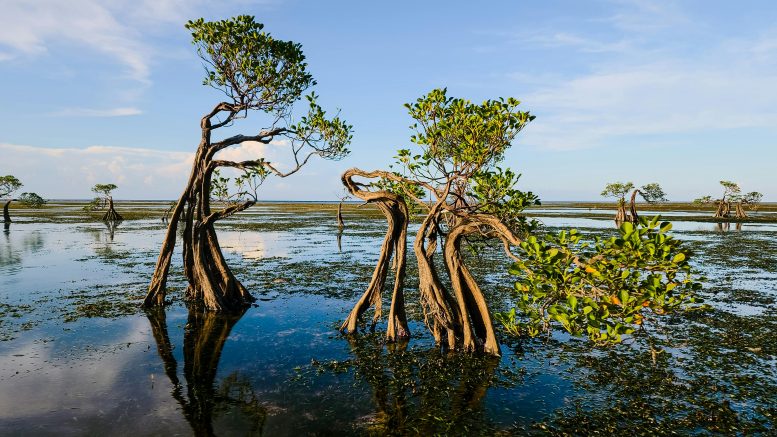
OECS Launches US$ 6.49M Mangrove Restoration Project in the Caribbean
Brazil
The Environment Institute of the Santa Catarina State reported an operation to control invasive exotic species removed nearly 30,000 pine trees from 160 hectares of natural grasslands in Serra do Cambirela, within Serra do Tabuleiro State Park. The work was completed after 85 days in a remote area and is part of an environmental licensing requirement overseen by Ibama. According to the agency, the measure supports native vegetation regeneration and helps protect headwaters that supply the cities of Florianópolis, Palhoça and São José. (IMA)
The Ministry of Environment and Climate Change of Brazil said it has begun discussions on certification methodologies for forest carbon credits under the National Commission for REDD+, in another step toward implementing the Brazilian Emissions Trading System. According to the ministry, the debate aims to assess the environmental integrity of these methodologies and support recommendations, by the end of 2026, on the accreditation of REDD+ projects and jurisdictional programs. (MMA)
The Brazilian Institute of Environment and Renewable Natural Resources said it inspected 47 cosmetic and pharmaceutical companies in 12 states to curb the irregular exploitation of traditional knowledge associated with biodiversity. Operation Guardians of Biodiversity, launched in March, has already resulted in 51 violation notices and US$ 440.9 thousand in fines, focusing on cases involving the use of knowledge held by Indigenous peoples and traditional communities without prior informed consent and without proper registration in SisGen. (Ibama)
The Brazilian Development Bank secured up to US$ 185 million from the Japan Bank for International Cooperation to support sustainable projects in Brazil. According to the bank, the funds will be directed to initiatives involving biofuels, power transmission, environmental preservation, emissions reduction, energy efficiency and renewable energy. The two institutions also signed memorandums of understanding to expand financial cooperation on infrastructure projects of mutual interest. (BNDES)
Ibama destroyed an aircraft used to support illegal mining activities in Almeirim, western State of Pará, during Operation Chironius. According to the report, the Cessna 182P had been modified for cargo transport and was found at a clandestine airstrip with fuel and machinery parts bound for illegal mining inside the Jari Ecological Station. The pilot was fined and both the aircraft and the cargo were destroyed because of the difficulty of removing them from the area. (Ibama)
The Government of the State of São Paulo opened a public consultation for the first State Plan to Combat Marine Litter, aiming to address marine pollution that impacts public health and the coastal economy. The proposal, developed by the Secretariat of Environment, Infrastructure and Logistics, will receive contributions until May 15 and highlights that plastics account for more than 90% of waste on São Paulo’s beaches. The initiative builds on ongoing actions, such as the Sea Without Trash program, which has removed more than 130 tonnes of waste from the ocean since 2022. (Government of São Paulo)
The Public Prosecutor’s Office of the State of Mato Grosso do Sul opened a civil inquiry to investigate the illegal clearing of 11.3 hectares of native vegetation in a legal reserve area within the Cerrado biome, in Cassilândia. The violations were identified by the State Institute of Environment of Mato Grosso do Sul, which imposed fines exceeding US$ 19,960, in addition to embargoing the area and requiring environmental restoration. The prosecutor’s office is assessing whether the measures taken are sufficient to ensure the full recovery of the degraded area. (MPMS)
A study published in Theoretical and Applied Climatology indicates that climate change could reduce water availability in the Corrente River basin, in the Matopiba region, by up to 77.9% by 2040, with more severe impacts than those caused by land-use changes. Under a high-emissions scenario, minimum streamflow could drop sharply, increasing the risk of water scarcity in one of the country’s main agricultural frontiers. (Theoretical and Applied Climatology)
The Government of the State of Rio Grande do Sul expanded air quality monitoring with new stations in the cities of Porto Alegre and Caxias do Sul integrated into the Rede Ar do Sul. The units measure pollutants such as particulate matter, ozone and nitrogen dioxide, with data already available to the public. The initiative, coordinated by the State Environmental Protection Foundation, also includes a station in Santa Maria and the hiring of a mobile unit to expand coverage across the state. (Government of RS)
The Federal Public Prosecutor’s Office launched a guide to strengthen investigations of environmental crimes using public data, bringing together open-source intelligence tools. Developed in partnership with the Igarapé Institute, the material provides guidance on using public records, satellite imagery and social media to identify irregularities and support evidence gathering. The initiative aims to expand investigative capacity and enhance the fight against environmental crimes in the country. Available at: https://tinyurl.com/48pthzc8 (MPF)
The Federal Public Prosecutor’s Office recommended the creation of a national system to monitor mercury contamination, focusing on the Amazon region, following the detection of high levels of the metal in fish and exposed populations. The proposal includes integrating environmental and health data, involving agencies such as Ibama and the Ministry of Health, as well as continuous monitoring across river basins. The initiative aims to strengthen responses to illegal gold mining and reduce health risks for Indigenous and riverine communities. (MPF)
Vale has signed an agreement with Shandong Shipping Corporation to charter second-generation Guaibamax vessels powered by ethanol, in a project expected to begin operations in 2029. The ships, measuring 340 meters with a capacity of 325,000 tonnes, will be the first in the world to use ethanol as their main fuel for transoceanic iron ore transport. According to the company, the initiative could reduce CO₂ emissions by up to 90% and is part of the Ecoshipping program, which aims to cut Scope 3 emissions by 15% by 2035. (Vale)
The Agriculture Committee from the Senate approved a bill that includes environmental protection and restoration services as rural activities for the purpose of calculating income tax. The proposal, which now moves on to the Environment Committee for review, provides that actions such as ecosystem conservation, restoration of degraded areas, and reforestation may be classified under the tax regime for rural activities. According to the rapporteur, Senator Alan Rick, the measure aims to provide legal certainty for producers who already engage in environmental practices and to encourage the adoption of conservation actions. ( Senate of Brazil)
The Brazilian Institute of Environment and Renewable Natural Resources received the Diploma of Honorary Merit from the Ambassador of Japan to Brazil, Noguchi Yasushi, in recognition of technical and scientific cooperation between the two countries in environmental monitoring and deforestation control. The partnership involves institutions such as JICA and JAXA and includes the use of satellite imagery, radar sensors, and artificial intelligence to improve the detection and prevention of environmental crimes in the Amazon. (Ibama)

Latin America
Conaf has imposed restrictions on the use of fire for agricultural and forestry waste disposals in the municipalities of Chillán and Chillán Viejo, in the Ñuble region of Chile. The measure, which will remain in effect until September 30, 2026, is part of the Air Pollution Prevention and Decontamination Plan established by the Ministry of the Environment. It aims to reduce the risk of forest fires and air pollution. (Conaf)
The Eastern Caribbean States Organisation, in partnership with the French Development Agency and the French Facility for Global Environment, has launched the REMAR Project, aimed at restoring mangroves in Eastern Caribbean countries. With an investment of US$ 6.49 million over five years, the initiative seeks to strengthen climate resilience, biodiversity conservation, and sustainable livelihoods in Grenada, Saint Lucia, Saint Vincent and the Grenadines, Martinique, and Guadeloupe. (OECS)
A report by the NGO Escazú Ahora revealed 2025 was the year with the highest number of attacks against environmental defenders in Chile since records began. The study identified 72 attacks against 67 people, a 148.2% increase compared to 2024. Women were the main victims, accounting for 55.2% of cases. The attacks occurred mainly in the Metropolitan Region, followed by La Araucanía, Los Ríos, and Valparaíso. (ONG Escazú Ahora)
The +Bosques Project has reached 96.6% progress in the Maule Region of Chile and is approaching its final implementation phase, with a focus on territorial equity and climate action. The initiative, led by Conaf and funded by the Green Climate Fund, includes restoration, conservation, and sustainable forest management activities across 3,750 hectares of native forest. The program has already mobilized more than US$ 64 million nationwide. In the Maule region, 202 agreements have been signed and around 250 people have been directly benefited, including small landowners, rural communities, and Indigenous peoples. (Conaf)
The Ministry of Environment and Sustainable Development of Colombia launched a rapid-response plan to curb the expansion of hippos in the country, an invasive species with more than 200 individuals. The strategy includes unprecedented euthanasia protocols, as well as translocation and sterilization, with an investment of US$ 2.02 million. The measure aims to reduce environmental impacts and risks to communities amid projections of rapid population growth through 2035. (Ministry of Environment of Colombia)
The Secretariat of Environment and Natural Resources of Mexico signed an agreement with avocado producers to combat deforestation associated with export production. The initiative establishes measures to protect, conserve, and restore ecosystems, including tackling illegal land-use change, adopting good agricultural practices, and implementing environmental compensation actions. The agreement also strengthens enforcement and aims to balance the sector’s economic development with the preservation of natural resources and ecosystem services. (Semarnat)
The Minister of the Environment of Mexico, Francisca Toledo Echegaray, ratified the appointment of Arturo Farías Alcaíno as the new Executive Director of the Environmental Assessment Service (SEA), designated by the President José Antonio Kast. Farías, a lawyer with about eight years of experience within the SEA, had previously served as head of the legal department and as the Metropolitan Regional Director. (Profepa)
The Ministry of Environment and Natural Resources of Nicaragua authorized 49 permits to export wildlife from licensed breeding facilities between February and March 2026, generating approximately US$1.47 million in revenue. In total, more than 18,000 specimens, including frogs, turtles, and snails, were exported to countries such as the United States, France, and Japan. The operations follow the rules of the Convention on International Trade in Endangered Species of Wild Fauna and Flora, aiming to ensure sustainable use and biodiversity conservation. (Marena)
The government of Panama created the Sierra Llorona National Park, a new protected area of approximately 16,400 hectares in the province of Colón, aimed to preserve ecosystems and biodiversity. The reserve is home to species such as jaguars, pumas, and tapirs, and also functions as a biological corridor between Chagres National Park and Portobelo National Park. The initiative also includes the construction of an ecological road with wildlife crossings, aiming to reduce roadkill and ensure connectivity between habitats. (Government of Panama)
The International Organization for Standardization has updated ISO 14001, the world’s leading environmental management standard, strengthening requirements for measurable results and greater integration with priorities such as climate change, biodiversity, and resource efficiency. The standard, adopted by more than 670,000 organizations worldwide, now places greater emphasis on demonstrating effective environmental performance, aligning governance and impacts across supply chains. (ISO)

READ MORE: