
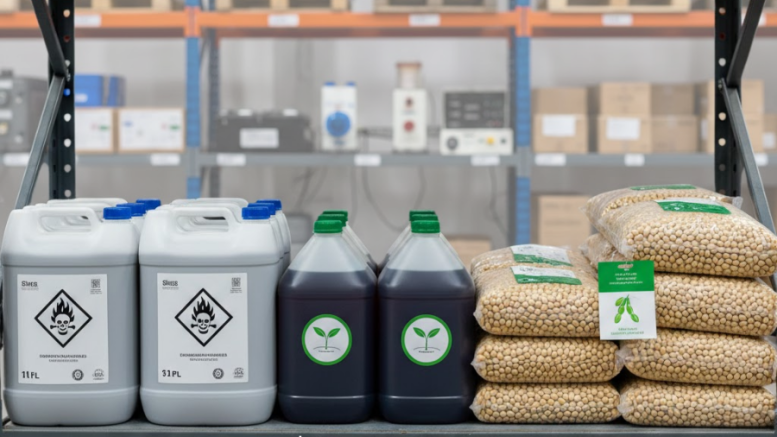
Brazil’s imports of crop protection products, biological inputs, and seeds totaled US$ 14.3 billion in 2025
Brazil
Anvisa publishes the withdrawal of requests for technical chlorantraniliprole and clomazone (Cropchem); technical chlorothalonil (Crystal); pyraclostrobin (Topazio); and propisochlor (UPL). (Official gazette of Brazil, Res. No. 263 from 01/22/2026, Anvisa)
Ministry of Agriculture has published requests of 47 registrations of equivalent technical products. (Official Gazette of Brazil, Act No. 4 from 01/20/26, Ministry of Agriculture)
Karime Nahass is the new Director of Marketing and R&D at Allterra, a company focused on soil health and plant nutrition. (Allterra)
Anvisa published a resolution setting additional requirements to speed up the review of technical-grade active ingredient equivalence petitions when increased or new impurities are identified compared with the reference product. The rule requires computational (in silico) predictive studies using at least three distinct expert systems and, depending on impurity levels, may require additional toxicology studies, including a genotoxicity test battery from 0.1% and above. It also makes the Declaration on the Toxicological Relevance of Impurities mandatory for cases still pending conclusion, including via an amendment when applicable. The resolution was republished to correct errors in the original publication. (Official Gazette of Brazil, RDC No. 1006, from 12/17/25, Anvisa)
Researchers from the Nuclear Magnetic Resonance New Research and Innovation Arrangement, supported by Fundação Araucária, are offering a free test in Paraná to identify adulterated crop protection products. A report by the Institute for Economic and Social Development of Border Regions estimates that 25% of such products sold in Brazil originate from illegal sources. In 2025, the Federal Highway Police reported a 257% increase in seizures of illegal pesticides in the State of Paraná, with 9 tonnes seized in October, compared with 3.5 tonnes in 2024. The service also supports inspection and security agencies and can be scheduled through the State University of Londrina laboratory. (Fundação Araucária; Governo do Paraná)
Sales of pesticides in Brazil hit a record in 2024, reaching 825.7 thousand tonnes of formulated products, according to a bulletin from the Brazilian Institute of the Environment and Renewable Natural Resources, based on self-declarations by registrant companies (which may contain inconsistencies). Glyphosate ranked first by volume (231.8 thousand tonnes), followed by mancozeb, 2,4-D, acephate and chlorothalonil; glufosinate (ammonium salt) moved up in the ranking and clethodim entered the top ten. Brazil’s Center-West recorded the highest volume, led by the State of Mato Grosso, and the agency also highlighted a fast growth in microbial biological inputs (89.3 thousand tonnes sold in 2024). (Ibama)
AgriConnection has concluded, together with Kea Capital Markets, the public offering of a US dollar receivables investment fund totaling US$ 20 million, described as the first US dollar FIDC dedicated to Brazil’s agribusiness sector. The transaction was completed in December of 2025. (AgriConnection; Kea Capital Markets)
Soybean and corn production costs in the State of Mato Grosso remain on an upward trend, driven mainly by crop protection expenses in soybeans and by higher seed and fertilizer costs in corn, while cotton shows a slight decline in operating expenses but an increase in total cost. For the 2026/27 soybean crop, operating costs were estimated at US$ 795 per hectare and the break-even price to cover the Effective Operating Cost was calculated at US$ 18.42 per 60-kg bag, below the current average forward price (US$ 19.9/bag). For corn, prices are enough to cover the Effective Operating Cost but not the Total Operating Cost and total cost, underscoring the need for tighter technical and commercial planning amid larger global supply and downward pressure on prices. (IMEA)
Embrapa identified isolated gene from Arachis duranensis (a wild ancestor of cultivated peanut), which triggers a defense “priming” mechanism that keeps plants on alert and increases tolerance to stresses such as drought, nematodes (Meloidogyne spp.), and fungal diseases, without yield penalties in transgenic trials. The technology is being patented and could support more sustainable breeding strategies, with potential to reduce reliance on chemical crop protection. (Embrapa)
In compliance with court decisions, Anvisa has approved the toxicological evaluation of the pesticides mesotrione and diquat (Somax); lufenuron (Rainbow); and Indoxacarb + bifenthrin + acetamiprid (Globachem). (Official gazette from Brazil, Res. No. 256 – 259 of 01/26/2026, Anvisa)
The lesser cornstalk borer (Elasmopalpus lignosellus) remains a significant threat to corn yields in Brazil, especially in the Cerrado, thriving under hot, dry conditions and in well-drained sandy soils, with the most critical damage occurring within the first 30 days after crop emergence. Recommended management combines preventive seed treatment, cultural practices (crop rotation and residue management), biotechnology and in-furrow technologies, plus close early-season monitoring and, when needed, targeted sprays to the plant base during cooler hours to limit losses in the 2025/26 crop. (Sindiveg)
Brazilian Association of Plant Nutrition Technology Industries will bring a debate on the future of plant nutrition and the role of specialty fertilizers to Fertilizer Latino Americano (January 26–28, Florida). Vice President Gustavo Branco is expected to highlight technologies such as enhanced-efficiency fertilizers, urease and nitrification inhibitors, and slow/controlled-release systems, while calling for greater technical rigor in environmental criteria and the use of carbon credits. The association also notes Brazil’s faster adoption of these solutions, with specialty fertilizers estimated at around 22% of the domestic market versus a global average near 5%. (Abisolo)
According to a survey conducted by the maritime agency Williams Brasil, the import of 5.16 million tonnes of fertilizers is scheduled for the period of January 1st to 19th. The largest share (1.56 million tonnes) is expected to be unloaded through the port of Santos, State of São Paulo. Next is the port of Paranaguá, State of Paraná, with 1.28 million tonnes. The report takes into account vessels already anchored, those waiting to dock offshore, and those scheduled to arrive by February 28th of 2026. (Williams Brasil)
Brazil’s imports of crop protection products, biological inputs, and seeds totaled US$ 14.3 billion in 2025. Chemical crop protection products accounted for US$ 13.8 billion (96.3% of the total), and import volumes hit a record 1.76 million tonnes, while average prices continued to fall as generics—especially formulated products—gained share. China remained the main source (US$ 6.0 billion), followed by India (US$ 2.0 billion) and the USA (US$ 1.6 billion); on the export side, agricultural inputs totaled US$ 976 million in 2025. (CropLife Brasil)
State of Santa Catarina now has a daily risk dashboard for the avocado seed moth (Stenoma catenifer) on Agroconnect, a platform that estimates annual generations, life-cycle duration and the spatial distribution of risk based on temperature-driven modeling. The tool is designed to support orchard establishment and management decisions as climate variability increases, especially in areas with lower frost risk. (Epagri)
Researchers published a review proposing criteria to define “truly sustainable” nanopesticides and mapping sustainable alternatives to synthetic polymers and surfactants. The study highlights natural, biodegradable materials (such as chitosan, lignin, cellulose and alginate), biosurfactants and natural-origin active ingredients to reduce volatilization and leaching losses and limit impacts on non-target organisms. The authors also flag scale-up and regulatory hurdles, including feedstock variability and the lack of specific protocols for nanoproducts. (USP)
Brazilian exports of agricultural inputs (chemical and biological crop protection products and seeds) totaled US$ 976 million in 2025, the best performance in 14 years and a 7% increase over 2024, according to CropData, a data portal from CropLife Brasil. In the same year, imports reached US$ 14.3 billion (1.8 million tonnes), driven mainly by chemical pesticides, with China as the top supplier (US$ 6.0 billion), followed by India (US$ 2.0 billion) and the USA (US$ 1.6 billion); the report also highlights rising imports of generic formulated products due to more competitive pricing. (CropLife Brasil)
Rising foliar disease pressure in Brazil’s soybean crop—led by Asian soybean rust (Phakopsora pachyrhizi)—is already a concern for the 2025/26 season, with eight outbreaks confirmed so far in municipalities in the States of Paraná, Mato Grosso do Sul and São Paulo. As planted area expands and production systems intensify, close field scouting and integrated disease management become critical, including rotating modes of action and using multi-site fungicides to reduce selection pressure. (Conab; Anti-Rust Consortium)
In 2025, the Campo Limpo System surpassed the cumulative milestone of 900 thousand tonnes of empty crop protection packaging sent to environmentally appropriate disposal in Brazil. In 2025 alone, almost 76 thousand tonnes were properly handled (about 11% higher than in 2024); according to the National Institute for the Processing of Empty Packaging, 100% of the collected material is correctly managed, with 92% recycled and the remainder sent to co-processing or incineration. Campo Limpo announced a US$ 26.14 million investment plan over the next three years to expand and optimize the production of resins, packaging, and caps made from this recycled plastic, including the installation of a new blow-molding machine; in 2025, the company invested about US$ 3.73 million, generated roughly US$ 93.36 million in revenue, and produced around 16 million recycled containers. (Campo Limpo; CropLife Brasil)
Inspectors from the Goiás State Agency for Agricultural Defense seized 1,409 irregular containers of alleged crop protection products (2,885 L) in Catalão, State of Goiás, after a truck was stopped on the BR-050 without required tax and sanitary documentation. The inspection found evidence of reused packaging, label inconsistencies (including toxicological classification) and manually applied date/lot/expiry stickers; the manufacturer named on the labels did not recognize the batch, and the person responsible was cited for counterfeiting and adulteration. (Agrodefesa)
Mosaic extended by 30 days the shutdown of single superphosphate production, at its Fospar plant, State of Paraná, and Araxá site, State of Minas Gerais. The company attributed the move to a recent and sharp increase in sulfur prices, a key input for SSP manufacturing. The stoppage was first announced on December 16th of 2025 for 30 days, alongside a halt in sulfur purchases, and Mosaic said it will keep monitoring market conditions to reassess production plans. (The Mosaic Company)
Manufacturing nitrogen fertilizers in Brazil using renewable feedstocks (such as ammonia made with renewable electricity and biomethane) is approaching the cost of domestic production based on natural gas. The analysis notes that hybrid projects in port areas can be cost-competitive versus grey and blue ammonia, but it does not compare these costs with imported fertilizer prices; it also highlights Brazil’s import dependence (97% of nitrogen fertilizers) and estimates a potential output of up to 3.8 million tonnes of nitrogen per year, contingent on coordinated policies, investment and infrastructure. (Instituto E+ Transição Energética)
Survey by the National Institute of Industrial Property indicates that biological-based fertilizers and crop protection products account for roughly 70% of Brazilian patent applications in “green agricultural technologies” from 2012 to 2025 (1,205 Brazil-origin filings). Including foreign filings, the share rises to 73%, totaling 3,282 applications for sustainable crop protection products and 2,597 for biofertilizers, ahead of digital agriculture. The report also ranks Brazil second in total filings (2,515), behind the USA, and highlights the Embrapa as the leading domestic applicant, with 34 projects over the period. (INPE)
Fertilizer trader Autem announced a US$ 5.7 million investment in a storage facility in the port zone of Paranaguá, State of Paraná, to ease logistics bottlenecks and raise distributed volumes from 220 thousand tonnes (2025) to 280 thousand tonnes in 2026. The warehouse, expected to be ready in the first half of the year, will have capacity for up to 75 thousand tonnes and will also provide services to other distributors; the company says port waiting times have reached 90 days and it is still seeking roughly US$ 1.33 million to finalize the project. (Autem Trade Company)
Fertilizer company Ibifert, from the State of Espírito Santo, plans to launch in 2026 an organomineral fertilizer produced from plant residues such as coffee straw. The company says studies indicate nitrogen content can reach up to 40%. Ibifert is building a pilot unit in Jaguaré (northern Espírito Santo) to start experimental production in March and move toward final clearance with Brazil’s Ministry of Agriculture; it aims to scale through smaller plants located closer to farms to cut logistics costs. (Ibifert)
Brazil’s Federal Government plans to phase out “ultra-hazardous” pesticides whenever there is an equivalent biological alternative or a less harmful chemical option, under the National Program to Reduce Pesticide Use, according to Agrarian Development Minister Paulo Teixeira. The proposal still needs review by an interministerial committee and validation by President Luiz Inácio Lula da Silva. (MDA)
The Federal Prosecutor’s Office (MPF) filed two strategic and parallel Public Civil Actions regarding the use of the herbicide atrazine in the State of Mato Grosso do Sul, focusing respectively on the Dourados River Basin (Dourados Federal Court) and the Upper Paraguay Basin (Corumbá Federal Court). Although they involve different territorial scopes, both lawsuits share the same objective: holding pesticide companies accountable for soil and water contamination to mitigate environmental damage and public health risks, and the determination for the agency to implement environmental monitoring programs for atrazine and initiate the procedure for its registration review. While Ibama’s manifestation occurs in the Dourados case to contest the request for a preliminary injunction within the 72-hour period granted by the court, the MPF’s petition refers to the Corumbá case, responding to a judicial order to justify why that sub-section would be the competent jurisdiction to judge the case instead of a state capital or the Federal District. (Ibama)

Latin América
Argentina’s National Service for Agri-Food Health and Quality held the first meeting of its Agricultural Consultative Roundtable in Patagonia, bringing together private-sector representatives from Neuquén, Río Negro, Chubut, Santa Cruz and Tierra del Fuego. The agenda focused on adapting and simplifying regulations to support production, safeguarding regional plant-health status and improving market access, as well as modernizing the Patagonia Zoophytosanitary Barrier and ensuring funding for the fruit-fly control and eradication program. The group also discussed streamlining phytosanitary registration for minor crops, enabling new technologies and advancing the phased rollout of Good Agricultural Practices in horticulture. (Senasa)
The Argentine Association of No-Till Farmers analyzed 224 soil samples in northern Santiago del Estero and found boron below the response threshold in 25% of sites and zinc in 95%. In 2025 trials, foliar applications delivered localized yield gains of up to 300 kg/ha (around +12%) in corn, underscoring the need to recalibrate nutrient management for corn, soybean and cotton in the region. (Aapresid)
João Roberto Galhardo is the new vice president of Supply Chain for Brazil and Paraguay at Mosaic. (The Mosaic Company)
National Service for Agricultural Health and Food Safety of Bolivia seized a warehouse in Santa Cruz holding roughly 38 tonnes of agrochemicals that did not comply with current regulations. The items included fertilizers, adjuvants, herbicides, fungicides and insecticides. Authorities said the action aims to protect the region’s phytosanitary status and reduce health and environmental risks. (Senasag)
Bolivia’s state-owned YPFB said its granular urea produced at the Bulo Bulo petrochemical complex, in Cochabamba, has been certified by the Bolivian Institute of Standardization and Quality, in line with ISO 18642:2024 requirements for fertilizer-grade urea. The company says the seal boosts customer confidence, differentiates the product, supports access to export markets and strengthens its goal of competing internationally, while supplying the domestic market and exporting surplus volumes. (YPFB)
Panama banned eight pesticides classified as highly hazardous due to risks to human health and the environment. The measure prohibits registration, imports, manufacturing, formulation, sales, use and distribution of the substances and grants an 18-month transition period to phase out existing stocks. The regulation also introduces partial restrictions on other active ingredients under heightened regulatory scrutiny. (MIDA)
READ MORE: