
“Glyphosate, glufosinate and chlorantraniliprole have all been re-priced since September. The driver is not demand. It is a cost-benchmarking mechanism that the government has now written into policy…”
Zhang Jinlong is an independent researcher with more than 20 years of experience in China’s agrochemical industry and over 15 years working with registration and sales for the Brazilian market. Specialist in product development, registration and Sales and Operations Planning (S&OP) management.
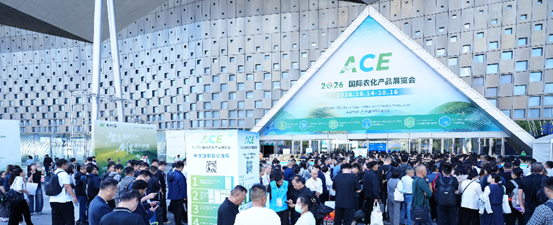
ACE 2026. The queue at the south entrance on the opening morning of 14 October. The organiser counts more than 100,000 visits over three days. Photo: AgroChemEx / CCPIA.
The 2026 AgroChem Exhibition (ACE) closed on October 16th at the Shanghai World Expo Exhibition and Convention Center. The organiser, the China Crop Protection Industry Association (CCPIA), ran the show across four full halls, H1 to H4, with close to 80,000 square metres of floor space, around 1,000 exhibitors and buyers from more than 120 countries. First-day attendance passed 50,000 on the organiser’s count, and by the close the association reported more than 100,000 visits across the three days. No audited figure has been released.
The order book did not match the floor space.
Producers would not quote, and would not take open positions. Glufosinate was being scheduled rather than sold. Glyphosate sellers held price and released little tonnage. Traders sat on stock. County distributors bought only for the day’s requirement, one or two lots at a time. The usual pre-winter stock build did not happen.
Chinese traders have a phrase for it: price up, goods tight, tickets small.
That is the fourth quarter in one line. A price list moving up against demand that has not arrived.
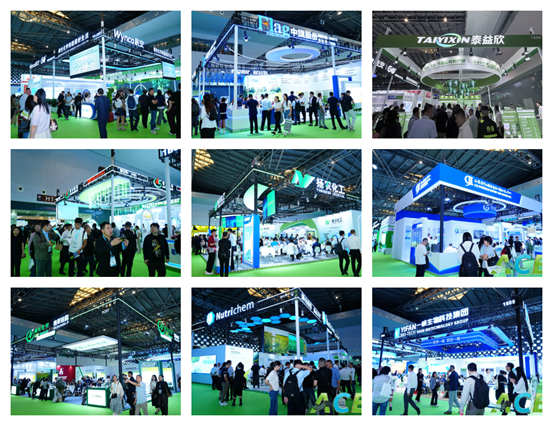
ACE 2026. Hall H1 Photo: AgroChemEx / CCPIA.
Two weeks, six re-pricings
The moves came after the show, not because of it. On October 18th, two days after the halls closed, the Sino-Agri Leading (SAL) index of technical material prices stood at 75.25, up 0.69% year on year and 2.53% month on month. A week earlier it was 73.79, down 1.26% year on year.
Technical material prices, 2026
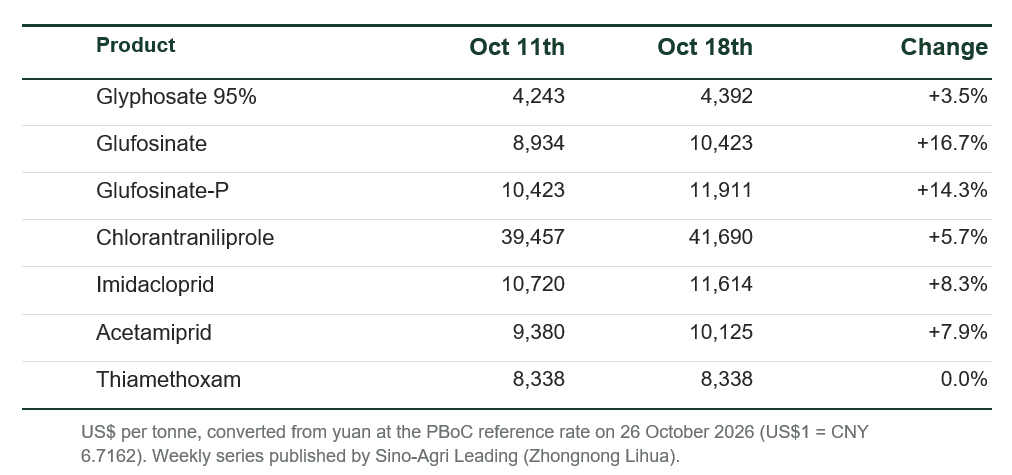
Glyphosate’s low was US$3,782/t on September 11th. By October 16th it traded at US$4,318/t, a gain of US$447/t in a month. Glufosinate had already set a year high of US$8,189/t to US$8,859/t in late September, up 12% to 18% since August, before the two weeks charted above.
Three products, three different reasons, one shared floor
Glyphosate is a cost story. Yellow phosphorus in Shandong went from US$3,975 per tonne on July 8th to US$4,281/t on October 16th; methanol in East China from US$384/t on August 5th to US$591/t. Glyphosate carries the largest capacity base in the industry, and channel inventory still has to clear. That caps the upside. The trade expects US$4,169/t to US$4,467/t through the winter.
Glufosinate is an intermediate story. Diethyl methylphosphonate (DEM) has been tight all year. Order books stretched and spot went short. Two policy decisions sit underneath: glufosinate production units are on the restricted list, and the export tax rebate on glufosinate and glufosinate-P technical was withdrawn from April 1st, 2026. By the week to 25 September the gross margin on glufosinate had recovered to US$377.71 per tonne, up 232.3% month on month. The move from late September’s US$8,189/t to US$8,859/t range to US$10,423/t on October 18th is 18% to 27% in three weeks, steeper than any change in the intermediate itself.
Glufosinate-P runs the same logic at higher amplitude. Effective capacity is concentrated, merchant volume is thin, and export and premium orders are scheduled first. It went from US$10,423/t to US$11,911/t in one week.
Chlorantraniliprole is a safety story. K-amine is a nitro-chemistry product. The Ministry of Emergency Management issued draft rules on 11 September to classify and consolidate nitro-chemistry producers. 2-nitro-3-methylbenzoic acid, the upstream of K-amine, went onto the hazardous chemicals catalogue in July. Non-compliant capacity has been cleared, and compliant capacity cannot replace it quickly. The price path this year: US$28.29/kg in January, a peak of US$47.65/kg in April, back to roughly US$32.76/kg in mid-year, then US$41.69/kg on October 18th.
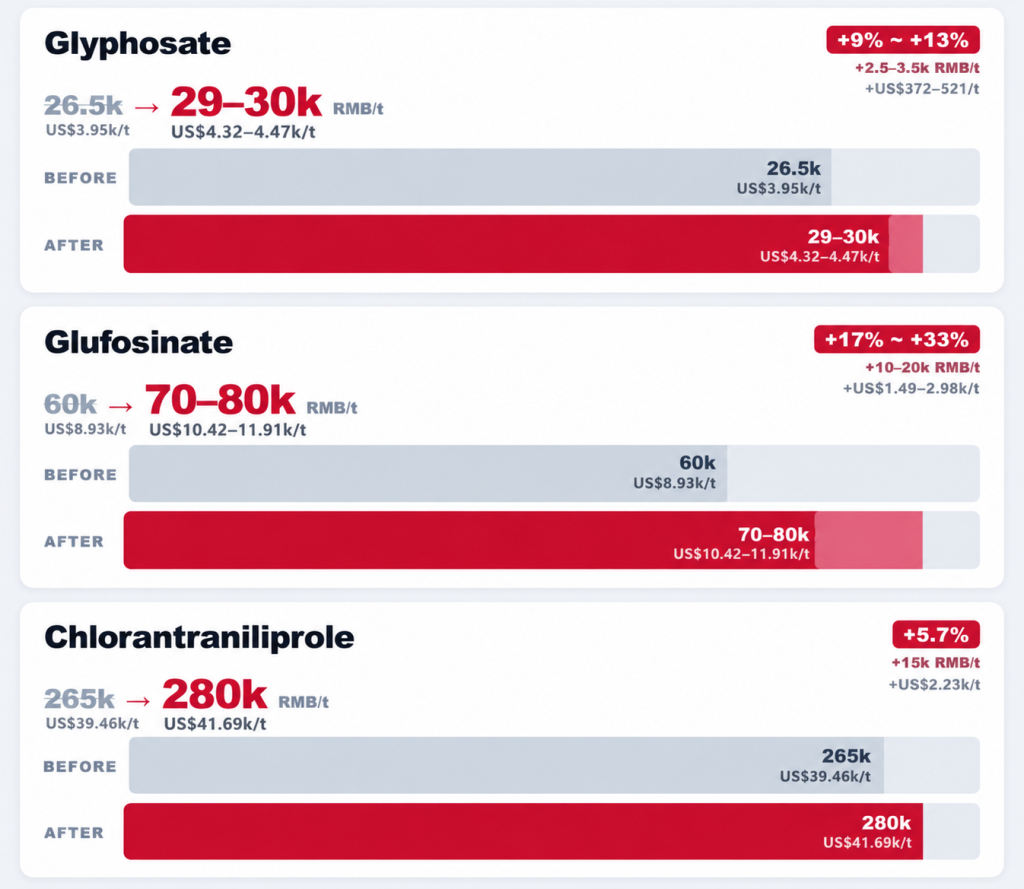
Quotes before ACE against October 20th. Grey is the level before the show (October 14th-16th); red is the quote a week later, with the solid segment at the low end of the range. Observation dates differ from the weekly series in the table above. Source: Sino-Agri Leading, data of October 20th 2026.
The floor has a number on it
What links the three is not the cost curve. It is a published number.
On February 10th 2026, CCPIA issued document Zhongnongxie [2026] No. 20, an initiative on regulating the production and business conduct of chlorantraniliprole. It measured the industry average cost at US$34,692 per tonne, excluding three expense items, and told members to align with it. It also named the practices it would treat as disguised below-cost selling: price-protection sales, invoicing for less than is shipped, rebates, returned goods, cash-back and discounts. Abamectin had the same treatment in December 2025, at US$67.45 per kilogram.
Then the government wrote the method into policy. Fagai Jiage [2026] No. 1303, signed on September 3rd and published on September 10th, sets out how below-cost competition in important industrial goods must be costed. Individual cost is the principle. Industry average cost applies where individual cost cannot be established. Capacity utilisation has to be taken into account. And industry associations are tasked with measuring that average, under the guidance of the National Development and Reform Commission and the market regulator.
“A plant quoting below the published average now has to defend its cost base to a regulator. A plant quoting above it does not.”
That is the part that changes behaviour. The enforcement sequence runs in two steps: warn first, then investigate cost. The result is a floor every seller can see, and no seller has an obvious reason to break.
The coordination groups hold it. CCPIA runs bulk-product groups under its self-discipline committee, covering glyphosate, glufosinate, chlorantraniliprole and abamectin. The glyphosate group met in Beijing on September 9th 2026, with all the leading producers in the room, and agreed to combine self-discipline with regulatory oversight. The glufosinate group met in Shanghai shortly before the ACE show, under a three-part theme: resist irrational competition, regulate industry order, advance industry governance.
On October 14th this year, opening the 26th China Pesticide Industry Exchange in the same venue as the show, CCPIA president Yan Duanxiang made the mechanism one of six tasks for the next five-year plan. The bulk-product groups, he said, should carry out cost measurement in a realistic way, jointly propose a reasonable cost range, and effectively observe the cost and price rules.
Six weeks ago I examined document 1303 and asked whether a cost-accounting rule could change pricing behaviour. The quote sheets since September are the first answer.
The followers
The nicotine insecticides moved a week behind the leaders. Imidacloprid went from US$10,720/t to US$11,614/t; acetamiprid from US$9,380/t to US$10,125/t. Thiamethoxam held at US$8,338/t. Cost pressure across the class is the stated reason. The timing is the tell: the nicotine products moved after the three flagship products re-priced, not before.
Breadth is still thin. Of the more than one hundred products in the index, 34% were up year on year on October 18th and 58% were down. Month on month, 35% were up and 16% were down. The index has turned positive. The market has not turned uniform.
Exports: three months down, and all three markets with it
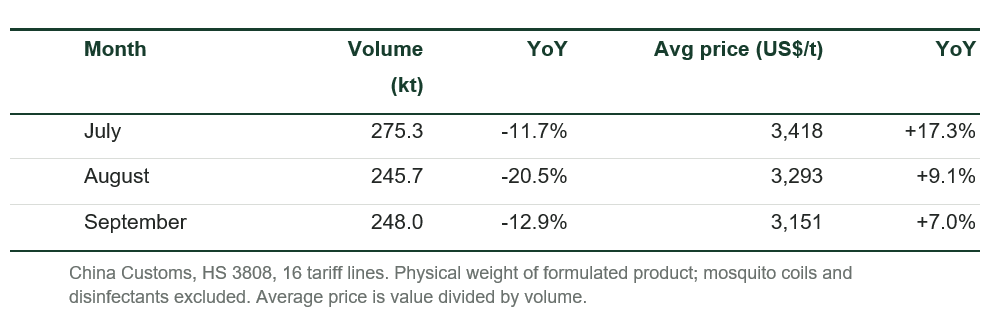
Jinlong Zhang tracks the customs data in real time and shares his analysis on October 21st. Formulated product exports from China were 248,000 tonnes in September, down 12.9% on the year. July was down 11.7%, August down 20.5%. September is the third consecutive fall.
China formulated product exports, 2026
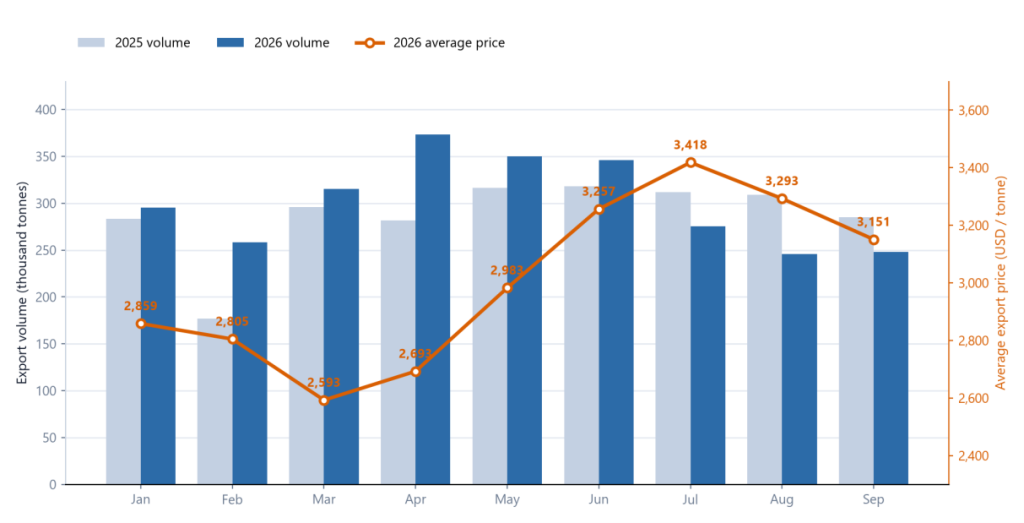
Formulated product exports, monthly volume and average export price. Source: China Customs (GACC), HS 3808, 16 tariff lines.
Value falls more slowly than volume. September was US$782m, down 6.8%, at US$3,151 a tonne, up 7.0%. That gap is what a price floor looks like on the trade account: fewer tonnes leave, at a higher price each.
The first half was the strong half. Volumes ran 15.9% ahead of 2025 from January to June. From July to September they ran 15.1% behind. Nine months in, exports are still ahead of last year at 2.707 million tonnes, up 5.0%, and US$8.09bn, up 10.0%. The year is not down. The momentum is.
September is also the first month this year in which all three major markets fell together. Brazil took 42,700 tonnes, down 42.4% — the deepest monthly fall of the year, and the third consecutive decline after a June peak of 106,600 tonnes, less than half of which survived into September. The United States turned: up 90.8% in July and 72.8% in August, then down 20.0% in September. Argentina fell 8.2%.
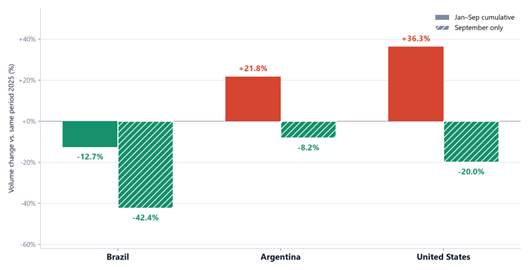
September against the nine-month cumulative, volume change versus 2025. September is the first month this year in which all three markets fell together. Source: China Customs (GACC), HS 3808.
The category split says where pricing power sits. Herbicides, 1.9 million tonnes over nine months, grew 2.3% in volume but 14.4% in value, average price up 11.9%. Insecticides went the other way: volume up 20.4%, value up 3.4%, average price down 14.1%. Fungicides lost 5.6% of volume and gained 6.3% on price.
That is the closest thing to a natural experiment in the data. Herbicides, where the coordination groups are oldest, show flat volume and rising price. Insecticides, where the groups are newer and thinner, show rising volume and falling price. Product mix explains part of that. It does not explain all of it.
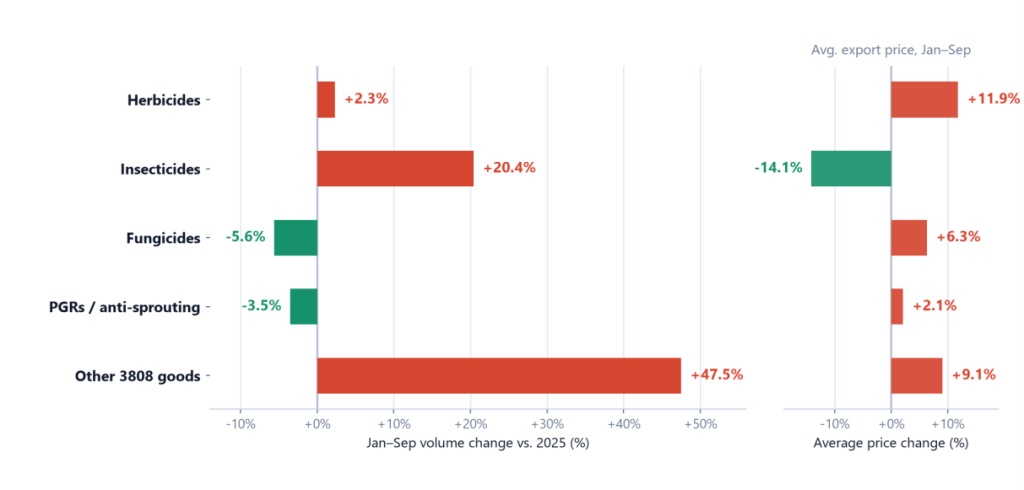
January to September change in volume and average export price, by category. Herbicides, where the coordination groups are oldest, show flat volume and rising price. Source: China Customs (GACC), HS 3808.
Three things are pressing on the fourth quarter at once. South America is at the tail of its season, and the tail is thin. North America should be opening its buying season, but the tariff fight pulled shipments forward into July and August and left September empty. And domestic winter storage has not started, because distributors will not carry inventory at these prices.
That is the standoff. Supply discipline is lifting prices into a demand gap. A floor can hold while volume falls. It cannot hold while volume falls and inventory builds.
What would break it
Whether winter storage opens at US$4,392/t glyphosate and US$10,423/t glufosinate. If distributors stay out through November, the floor holds on paper and the inventory sits with the plants.
Whether exports stabilise. September’s fall was narrower than August’s and the value line held. Two more months of single-digit decline would mean the floor is being absorbed by the market. A return to the August rate would mean it is not.
Whether the cost-benchmark model spreads. Four products now carry a published cost number. The nicotine class, at US$11,614/t for imidacloprid, does not.
Whether diethyl methylphosphonate eases. Glufosinate is the strongest of the three markets and the one most exposed to a single intermediate.
READ MORE: