
“Waterway transportation in Brazil is still constrained by a lack of basic infrastructure and year-round operational predictability…”
João Paiva is global director of ports and waterways at Louis Dreyfus Company – LDC and a production engineer from the Federal University of Viçosa.
Paiva holds a postgraduate degree in Logistics and Supply Chain Management from Fundação Getulio Vargas and a specialization in Port Management, Waterway Transportation and Multimodal Transportation from ITL – SEST SENAT – CNT and Erasmus University Rotterdam.

João Paiva, director of ports and waterways at LDC
AgriBrasilis – Why is waterway transportation still underused in Brazil?
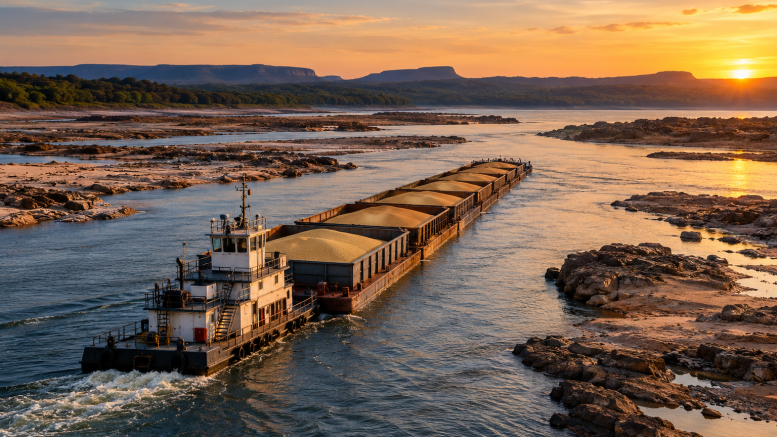
João Paiva – Waterway transportation in Brazil is still constrained by a lack of basic infrastructure and year-round operational predictability. Agricultural production expanded rapidly, but waterways did not receive sufficient investment to keep pace, including dredging and rock removal works. This makes navigation more vulnerable to climate-related fluctuations that lower water levels, as occurred during the drought that halted operations on the Tietê-Paraná Waterway between 2020 and 2022 and also affected rivers in northern Brazil in 2024. For the modal to expand, the country needs continuous investment to ensure navigation throughout the year.
AgriBrasilis – How do you assess agricultural logistics and the integration between transportation modes?
João Paiva – In a continental-sized country such as Brazil, efficient crop transportation necessarily requires multimodality. Trucks play an essential role in the first leg, carrying grain from farms to transshipment terminals. From there, waterways handle large volumes with economies of scale and lower environmental impact through reduced emissions.
On the 640-km route we operate along the Tietê-Paraná Waterway, between São Simão, State of Goiás, and Pederneiras, State of São Paulo, each barge convoy removes approximately 150 trucks from highways. In Pederneiras, cargo is transferred directly to the railway network and transported to the Port of Santos through a fast and continuous loading operation. This integration between waterways and railways reduces pressure on highways, improves road safety and significantly cuts carbon emissions.
AgriBrasilis – To what extent can waterways reduce grain logistics costs?
João Paiva – Freight has historically been one of the largest components of grain costs in Brazil. The main advantage of waterways is energy efficiency and economies of scale: a single convoy can transport volumes equivalent to hundreds of trucks while consuming a fraction of the fuel per tonne.
This substantially reduces the cost per tonne-kilometer, making Brazilian products more competitive in export markets. Combining waterway transportation at scale with rail connections to ports not only reduces long-haul freight costs but also protects farmer margins and improves predictability across the supply chain.
AgriBrasilis – Where is the greatest potential to expand waterway transportation and what still prevents this expansion?
João Paiva – The main potential for expansion is currently divided into two complementary fronts. In the Northern Arc, strengthening Amazon basin waterways such as the Tapajós, Madeira and Tocantins-Araguaia corridors can shorten shipping routes to global markets. In the Center-South, established corridors such as the Tietê-Paraná and Paraguay waterways could handle much larger volumes if better integrated with the railway network.
What prevents this expansion is not demand from agriculture or private investment in fleets and terminals, but hydrological and regulatory uncertainty. The sector lacks a permanent, long-term program to maintain navigable draft through continuous dredging and rock removal at critical points, such as Pedral do Lourenço, as well as clear governance rules for the multiple uses of water, particularly between hydropower generation and navigation.
Without guaranteed draft throughout the year and more efficient environmental licensing, private companies operate under higher risk and the country underuses one of its most competitive natural infrastructure assets.
AgriBrasilis – How do drought, draft and dredging affect waterway costs and reliability?
João Paiva – The interaction between climate, draft and dredging directly determines the economic efficiency of waterway transportation. When drought reduces water depth, operations immediately face capacity restrictions. Barges must operate at a reduced draft, carrying less cargo, or convoys must be split and reconfigured to navigate critical sections and winding stretches with shallower water.
In practical terms, moving less cargo with the same fixed costs for towboats, crews and fuel increases freight costs per tonne and creates uncertainty for exporters that must meet loading windows at seaports.
This is precisely where dredging and preventive maintenance should be viewed not as costs, but as investments in stability. Regular and preventive interventions keep navigation channels operational even in years with challenging hydrological conditions, allowing waterways to remain competitive and provide the predictability agribusiness requires.
AgriBrasilis – LDC recently tested a 25-barge convoy on the Tapajós River. What does this operation reveal about the gains and limits of scale in river transportation?
João Paiva – This operation between Miritituba and Santarém shows that scale in river transportation can expand sustainably when operations are designed for the specific conditions of each river. The results establish the 25-barge configuration as another efficient alternative within our Tapajós logistics network, allowing larger volumes to be transported with lower relative fuel consumption and consequently lower carbon emissions per tonne.
Rather than simply testing operational limits, the project demonstrated that economies of scale must respect local channel characteristics, including current patterns, depth and turning radius. Before operating the convoy, we conducted hydrodynamic simulations at maneuvering centers, trained crews for the new configuration and obtained all technical approvals from the Brazilian Navy port authority after months of risk analysis.
This demonstrates that agricultural logistics productivity can be increased while respecting river conditions and maintaining high standards of navigation safety.
READ MORE: