
“The agronomist who uses AI will replace the one who does not…”
Guilherme Sanches is the creator of OagronomIA – Agriculture in the World of AI, a project aimed at training agricultural professionals for the age of artificial intelligence. Sanches has a degree in Agricultural Engineering from the University of Campinas, M.Sc., Ph.D. and postdoctoral qualifications from leading universities in the State of São Paulo (USP, Unicamp and Unesp), and is a specialist in Artificial Intelligence and Big Data from the Institute of Mathematics and Computer Sciences of the University of São Paulo (ICMC/USP).

Guilherme Sanches, creator of OagronomIA
AgriBrasilis – How far can artificial intelligence go in agriculture?
Guilherme Sanches – Honestly, nobody knows. Anyone who claims to know is merely guessing. This technology is advancing so quickly that any long-term prediction made today becomes outdated within six months.
That is why I prefer to turn the question around. Instead of trying to predict how far AI will go, it is more useful to examine our problems and consider how AI could advance to solve them. The greatest of these problems is the shortage of labor in rural areas. Very soon, there may not be enough people to harvest oranges, plant crops or operate tractors. The rural workforce is aging, and young people are not returning to the countryside.
In this context, AI and automation are no longer trends; they are necessities. This is a food security issue, not merely a productivity issue. China understood this long ago and is aggressively automating and robotizing its agricultural sector. My answer, therefore, is that AI will go as far as we need it to go for us to continue producing food. The sooner we recognize this and adapt, the better it will be for us, our businesses and our country.
AgriBrasilis – What are the most relevant applications currently available?
Guilherme Sanches – It is important to separate them into two areas because they are at very different levels of maturity.
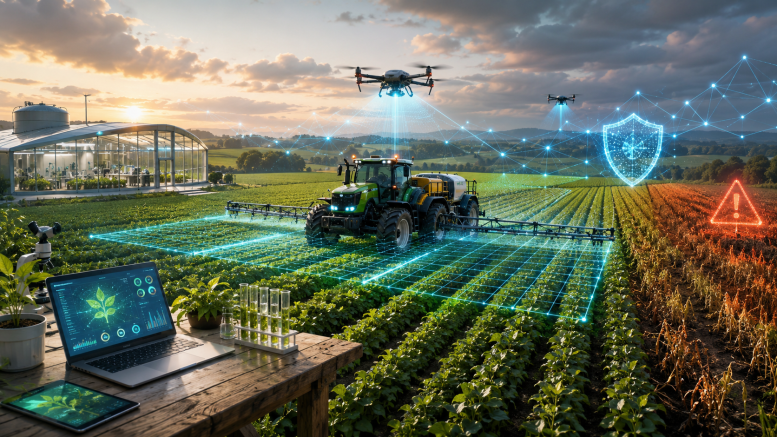
The first is non-generative AI, including computer vision and machine learning, which have been used in agriculture for quite some time through machinery and software, often without farmers even realizing it. Applications include crop monitoring, the identification of pests, diseases and weeds, yield and weather forecasting, the analysis of satellite and drone imagery, and predictive maintenance for machinery. The most emblematic example is selective spraying, in which cameras and algorithms identify weeds in real time and apply herbicide only where necessary. In some cases, this has reduced herbicide use by more than 50%.
The second area is generative AI, including ChatGPT, Claude and Gemini. Here, we are still at the beginning. These tools already help users answer questions, review documents, conduct research more quickly, analyze data, organize information, and prepare reports and technical consultations. This area has enormous potential, but its use in the field remains limited, and its actual benefits in terms of productivity and costs have not yet been adequately measured.
AgriBrasilis – How is this technology used in crop management recommendations, plant nutrition and phytosanitary control?
Guilherme Sanches – There is enormous enthusiasm surrounding this subject, but I need to be honest: generic AI—the kind we access online through a chat interface—produces mediocre recommendations when used without proper preparation. You ask an AI tool about fertilization and receive an attractive, well-written but completely superficial answer. It may be suitable for a university assignment, but not for making a decision involving 1,000 hectares.
What changes the game is context. When AI is provided with the soil analysis for a specific field, its yield history, regional recommendation guidelines, the results of cooperative trials and the products that are actually available, the answer begins to make agronomic sense. That is the difference between an AI system that produces a generic response and one that has been supplied with relevant content.
In crop management and plant nutrition, AI currently contributes primarily to data processing and interpretation. It can organize soil analyses, cross-reference information from different fields, generate maps and management zones, compare trial results, and transform all this information into reports. In phytosanitary management, computer vision can already identify the target and the severity of an infestation, while machine learning can help determine the best application window by considering wind, temperature, humidity and rainfall forecasts.
However, none of this works independently. Without properly trained professionals and without providing the tool with the correct context, the result is a generic recommendation disguised as technical advice. That is worse than not using AI at all.
AgriBrasilis – Which agricultural professionals will be most affected by AI?
Guilherme Sanches – Before answering, I would make one observation: I see agriculture as a sector full of opportunities precisely because it has not yet been significantly affected. Marketing, computing, law and design have already experienced major disruption from AI. Agriculture has not. This means that those who position themselves now will gain a significant advantage.
That said, only one type of professional will be most affected: the one who fails to adapt to the new reality.
I like to draw a comparison with Excel—the spreadsheet software. Twenty years ago, agronomists who continued recording everything in notebooks and refused to learn how to use spreadsheets fell behind. Excel itself did not take their jobs; their colleagues who learned how to use Excel did. The same situation is now repeating itself: professionals who insist on relying solely on spreadsheets and do not begin incorporating AI into their daily work will be significantly affected.
AI will not replace agronomists. However, agronomists who use AI will replace those who do not.
AgriBrasilis – Which AI-related skills will become indispensable?
Guilherme Sanches – Operational work will increasingly be performed by AI. Repetitive tasks such as pressing buttons, entering data, searching online, and copying and pasting information into spreadsheets can all be performed more quickly and effectively by AI. Professionals who have built their careers around these tasks will need to reinvent themselves.
What remains for us—and will become considerably more valuable—is reasoning, problem-solving and the practical application of knowledge. Professionals must understand farmers’ challenges in depth, identify the actual problems in the field, and possess enough technical knowledge to determine whether an answer makes agronomic sense.
Combine this with proficiency in AI and you have the most valuable skill for the coming years: the ability to take a real problem, use AI tools effectively and deliver a solution that genuinely solves it. This does not mean becoming a programmer. It means becoming a professional who knows how to ask the right question and critically evaluate the answer.
This cannot be learned merely by watching videos. It is learned through daily practice, just as it was with Excel.
AgriBrasilis – What are the risks associated with the use of AI?
Guilherme Sanches – The greatest risk is not knowing how to use it. The problem is not the technology itself, but the lack of preparation among those operating it. This includes someone making decisions based on an answer they are unable to evaluate critically, unknowingly exposing confidential company data, or trusting a figure fabricated by the tool. The greatest risk is naïve use.
I draw a comparison with the internet. When it first emerged, we fell victim to all kinds of scams, had our data exposed, bank accounts hacked, and encountered viruses and fraudulent emails. It was a confusing and unsafe period. What did we do? We did not stop using the internet. We learned how to use it safely, established rules, created strong passwords and developed a healthy degree of skepticism.
AI is exactly the same. Is it 100% safe? No technology is. There are genuine risks of information leaks, incorrect answers being presented with great confidence, excessive dependence on the technology, and a loss of critical thinking. However, the solution has never been to avoid the technology, but to learn how to use it safely.
That is why I always return to the same point: training. It is what separates those who use AI safely from those who expose themselves to risks without realizing it.
READ MORE: