
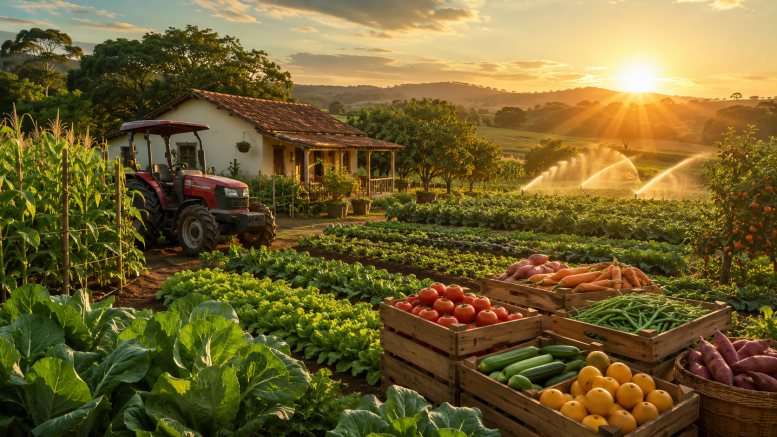
Brazil Launches US$ 18.8 Billion Family Farming Harvest Plan

Economic activity declined in April 2026 compared with March (-1.5%), but grew year-over-year (+1.6%), driven by agriculture, livestock, hunting and forestry (+10.9%) and mining and quarrying (+17.1%). In foreign trade, agroindustrial exports reached a record 53 million tonnes from January to May, with sales to more than 130 destinations. Beef exports reached US$ 1.76 billion in the period, with increases in value (+46%) and volume (+11%), led by the US, which purchased 42.8 thousand tonnes (+151%). China remained as the main destination by volume. (Indec; Government of Argentina)
Excessive moisture and low temperatures are delaying grain planting and harvesting. Wheat planting reached 65.8% of the 6.5 million hectares projected for the 2026/27 season, 5.9 points below the five-year average. Barley reached 34.6% of the suitable area, also below the historical average. For summer crops, soybean harvest reached 98% of the area, with production estimated at 50.1 million tonnes, while corn harvest reached 51.2%, with output projected at 64 million tonnes. (BCBA)

Brazil will allocate US$ 100 million to the Fund for Structural Convergence of Mercosur, which seeks to reduce inequalities among countries and regions within the South American bloc. The fund supports projects in areas such as roads, railways, energy, sanitation, housing, schools and laboratories. It currently aims to receive up to US$ 100 million per year from all Mercosur countries. Brazil and Argentina are the largest contributors, accounting for approximately 70% and 27% of contributions, respectively. (MRE; Mercosul/FOCEM)
The 2026/2027 Harvest Plan [Brazilian Government agricultural financing plan] will allocate approximately US$ 101.57 billion to commercial agriculture, aimed at medium and large farmers (+US$ 1.74 billion from the previous season). Of the total, approximately US$ 74.45 billion will be allocated to working capital and commercialization credit, while approximately US$ 27.12 billion will go to investments in modernization, storage, irrigation, technology and machinery. The National Program to Support Medium-Sized Farmers will receive approximately US$ 14.04 billion, with a maximum interest rate of 9% per year. Despite the record amount, the Federation of Agriculture of the State of Paraná and the Rural Learning Service of Paraná said the credit lines remain unattractive, citing still-high interest rates, difficulties in accessing credit and the lack of a structured policy for debt renegotiation and rural insurance strengthening. (MAPA; Sistema FAEP)
SLC Agrícola and Bom Futuro Agrícola said they had exercised preemptive rights to acquire the entire State of Mato Grosso Block owned by Radar Group for approximately US$ 357.83 million. The portfolio comprises nearly 41.2 thousand hectares, including 28.8 thousand hectares of arable land. SLC said it already operates 17.6 thousand hectares within the block and that the transaction would be structured on a “closed-gate” basis [as a single package], including the assets as offered. Bom Futuro said it exercised its right of first refusal as the lessee of the area, citing alignment with its expansion strategy in the State of Mato Grosso. (SLC Agrícola; Bom Futuro Agrícola)
Raízen released the 4Q 2025/2026 results on June 29th amid a financial restructuring process relevant to the sugar, ethanol and fuel distribution chain. The company said the out-of-court restructuring plan covered US$ 12.51 billion in unsecured financial claims, with creditor support reaching 80.15% of restructured claims. (Raízen; CVM)
The 2026/2027 Family Farming Harvest Plan [Brazilian Government agricultural financing plan] will allocate more than US$ 18.76 billion to the sector, including US$ 16.48 billion in rural credit. The launch also included the Terra à Mesa program, with US$ 79.96 million for climate adaptation in Brazil’s semi-arid region, benefiting 63.6 thousand families in ten states. (MDA)
Net revenue of Brazil’s machinery and equipment industry reached approximately US$ 4.33 billion in May 2026 (-20.4%). Domestic revenue reached approximately US$ 3.33 billion (-23.2%), while exports totaled US$ 1.04 billion (+5.5%). The Brazilian Machinery and Equipment Industry Association revised its 2026 forecast and now expects a decline in the sector’s net revenue (-3.2%). For agricultural machinery, the entity expects a decline this year (-15% to -20%) and classified the 2026/27 Harvest Plan [Brazilian Government agricultural financing plan] as neutral for the segment. (Abimaq)
Inpasa is seeking to raise approximately US$ 192.31 million in corporate bonds to finance expansions and improve the capital structure. The company, which is Latin America’s largest corn ethanol producer, has new projects in the cities of Rio Verde, State of Goiás, and Rondonópolis, State of Mato Grosso, as well as expansions at existing units. The target is to reach annual production of 8 billion L of corn ethanol by 2027. (Inpasa; CVM)
Grão Direto launched “Mercado 24h” [24h Market] and commercialized more than 55 thousand tonnes of soybeans and corn outside traditional trading hours in less than three months. The feature, tested with ADM and other grain traders, has already exceeded 100 closed deals and is equivalent to the volume of a loaded vessel. The platform combines digital grain trading, real-time pricing, artificial intelligence and financial services. (Grão Direto; ADM)
B3 and Polato Sementes carried out the first public Rural Product Note [agribusiness receivables note] indexed to the US dollar for individual investors. The issuance, structured by Itaú BBA, raised approximately US$ 26.35 million and was divided into two series. According to B3, the transaction expands fundraising alternatives for agribusiness companies and creates a new investment option linked to the sector. (B3; Polato Sementes; Itaú BBA)


Fruit exports totaled US$ 3.84 billion from January to May 2026 (-10.7%), pressured by lower returns from cherries and grapes. In contrast, nut exports reached US$ 206 million (+31%), while seeds totaled US$ 207 million (+5%). The food industry reached US$ 5.98 billion in exports (+3.3%), led by salmon, trout and frozen fruit. (SUBREI)
Ferrero announced a US$ 94 million investment in Chile to strengthen the hazelnut supply chain. The plan includes upgrades in plants in Maule and Ñuble, expansion of the logistics network and construction of a new facility in Cunco, in La Araucanía region, which is to receive approximately US$ 45 million. The company has already invested US$ 330 million in the country and exports approximately US$ 600 million per year in hazelnuts through Chilean ports. (Ferrero)
Agrícola Ancali is preparing to enter the consumer market with a proprietary brand of milk, yogurt and cheese. The company, linked to the Heller family, operates the world’s largest robotic dairy farm, with annual production of 70 million L and a herd of 9 thousand cattle. The plan includes starting with a direct-to-consumer model and moving into retail in 2029, in addition to expanding in nuts, with 1.1 thousand hectares of hazelnuts and a target of producing 5 million kg within five years. (Agrícola Ancali)

The Regional Autonomous Corporation of Cundinamarca launched the “Climate Preparedness Route” to prepare 98 municipalities in Cundinamarca, six in Boyacá and rural Bogotá for the effects of El Niño. The strategy includes identifying the most vulnerable municipalities and economic sectors, providing technical assistance, preparing specific plans for each type of user and monitoring the measures adopted. The focus is to reduce risks of forest fires, water shortages and impacts on productive activities. (CAR Cundinamarca; Ideam)
The Ministry of Agriculture allocated approximately US$ 27.5 million to support the purchase of inputs, fertilization and soil cover amid risks associated with El Niño. The government also launched a special credit line for agricultural risk management, aimed at irrigation improvements, precision irrigation and drought-related infrastructure. For 2026, approximately US$ 100 million was allocated to the agricultural financing program. (Ministry of Agriculture)
The Ministry of Agriculture reported that 442 thousand hectares were acquired through direct purchases for the agrarian reform, in addition to 24 thousand hectares received through donations and other no-cost transfers. According to Minister Martha Carvajalino, another 314 thousand hectares came from agrarian proceedings, totaling 806 thousand hectares incorporated into the National Land Fund. In land formalization, the government reported progress on 2.2 million hectares, of which 1.2 million already have registered titles. (Ministry of Agriculture)
The Ministry of Agriculture confirmed the National Federation of Coffee Farmers is the most representative organization of coffee farmers in the country. The federation was the only entity that met the legal, technical, territorial and democratic governance requirements to manage the National Coffee Fund. The report indicated 55% electoral participation among members, coverage of 64.4% of farmers registered in the Coffee Information System and presence in 59.35% of coffee-farming municipalities through committees. The study recommended increasing the participation of women, young people and ethnic communities. (Ministry of Agriculture)
Colombia vaccinated 22.7 million cattle and buffaloes against foot-and-mouth disease in the first vaccination cycle of 2026, equivalent to 77.1% of the national herd. The campaign reached 80% of the country’s farms. Another 1.2 million heifers were vaccinated against brucellosis, while 7.3 million animals were protected against sylvatic rabies. Coverage was affected by public order issues in regions such as Caquetá, Bolívar and Magdalena. (Fedegán; ICA)


Mexico is expected to increase rice imports in 2026/27. The country should import 830 thousand tonnes of milled rice, up from 800 thousand tonnes in the previous cycle, while domestic production is expected to reach 192 thousand tonnes. (USDA; Government of Mexico)
Mexico is expected to remain the world’s largest corn importer until 2035, accounting for 10% of global purchases, and to become the fifth largest consumer market for the grain, with 4% of global demand, behind the USA, China, Brazil and the EU. The outlook highlights the gap between domestic consumption and local production. In the livestock sector, Mexican live cattle exports are expected to normalize in 2027, provided the effects of the New World screwworm outbreak are overcome. The country also started operations at a sterile fly production facility against New World screwworm (Cochliomyia hominivorax) in Metapa de Domínguez, Chiapas. The plant is expected to start with 28 million sterile flies per week by mid-July and increase to 100 million per week by the end of 2026. USDA reported a US$ 21 million investment to support the facility in Mexico and up to US$ 100 million for new technologies against the pest. (OECD; FAO; Senasica; USDA/APHIS)

Paraguay defended a more equitable distribution of export quotas under the Mercosur–EU agreement. During a meeting of the Common Market Council in Asunción, Foreign Affairs Minister Rubén Ramírez Lezcano said the volumes proposed for the country do not adequately reflect its production capacity or the commitments assumed under the agreement. According to the minister, Paraguay is not seeking privileges, but fair treatment within the bloc. The country also highlighted progress in trade facilitation, logistics, the digital agenda and negotiations with the United Arab Emirates, Canada, India, Japan and Vietnam. (Ministry of Foreign Affairs)
Total exports reached US$ 7.91 billion through May 2026 (+16.4%). Registered exports totaled US$ 5.38 billion (+18.3%), mainly driven by higher shipments of soybeans, soybean oil and soybean meal. Exports under the maquila regime [a special manufacturing-for-export system] reached US$ 596 million (+30.7%). (Central Bank)
JBS is expanding in Paraguay with an investment of approximately US$ 185 million in a poultry complex in Campo 9, department of Caaguazú. The project includes farms integrated into the company’s production chain and strengthens the animal protein expansion strategy in the country. The initiative involves production, integration with farmers and value addition to the agroindustrial chain in Paraguay. (Ministry of Industry and Commerce)

Agricultural exports reached US$ 4.6 billion from January to May 2026 (+6.75%), a new record for the first five months of the year. Growth was driven by grapes, blueberries, avocados and quinoa, offsetting declines in coffee and cocoa, which were pressured by lower prices. Despite the positive result, the Hass avocado export campaign has started to adjust: after reaching approximately 60% of the estimated 2026 volume, the initial growth estimate compared with 2025 (+6%) was revised, and the season is expected to close with a volume similar to last year. Higher temperatures affected fruit development, increased the share of smaller-sized fruit and reduced exportable supply for the second half of the campaign. The country’s agricultural exports are projected to reach between US$ 15.56 billion and US$ 16.02 billion in 2026. (MIDAGRI; ProHass)
Machu Picchu Foods became the largest exporter of agricultural goods in Peru from January to May of 2026, with US$ 137 million in exports. The company works with more than 2.2 thousand employees and thousands of cocoa farmers, consolidating Peru’s advance in higher value-added agroindustrial products. (SUNAT; Machu Picchu Foods)
Inka’s Berries expects to exceed 1 thousand containers of exported blueberries in the 2026/2027 season, with more than 13 million kg shipped to markets such as North America, Europe, Asia and the Middle East. The company estimates total production of 15 million kg and is betting on proprietary genetic varieties developed for greater resilience to climate anomalies associated with the El Niño weather event. (Inka’s Berries)

Exports reached US$ 1.31 billion in June 2026 (-4%), marking a second consecutive monthly decline, but with a reshuffling of the export mix. Beef led exports during the month, with US$ 251 million (+11%), and was also the main product in the first half of the year. Pulp (+4%), live cattle (+75%) and dairy products (+8%) increased, while soybeans fell (-53%) after supporting part of May’s positive performance. China remained the leading destination, although the country’s purchases declined (-42%). (Uruguay XXI)

READ MORE: