
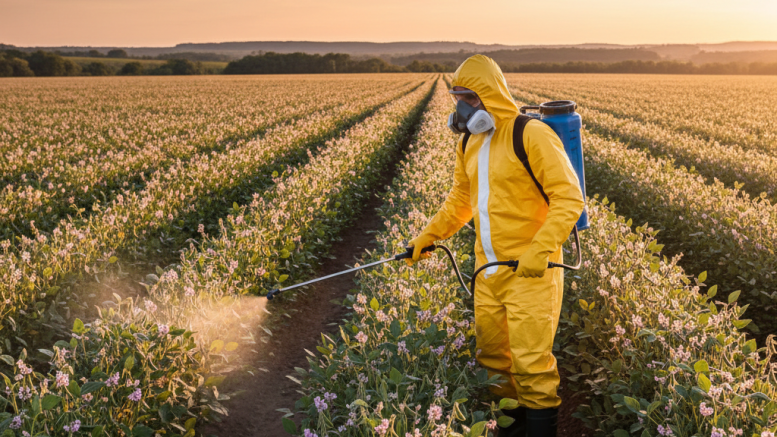
Application of Several Insecticides Has Been Prohibited in the Presence of Flowers in Soybean Crops in Uruguay
Brazil
Operation “Triângulo” was launched in the state of Minas Gerais and seizured 21 tonnes of irregular, counterfeit and smuggled pesticides. The joint operation, which used multiple security forces and chemical analysis technology, strengthens the fight against the illegal market to ensure sector competitiveness, environmental protection and the safety of public health and national agricultural production. (MAPA)
In 2025, Yara’s revenue was US$ 15.7 billion and a significant jump in net profit to US$ 1.37 billion, driven mainly by the 11.4% growth in delivery volume in the Brazilian market. Despite retractions in North America and in ammonia production, the global performance was consolidated with a 2.9% increase in total sales, reversing the marginal result of the previous year and strengthening the company’s position in Europe and in Brazil. (Yara)
With the objective of raising the precision standard in perennial crops such as coffee and fruits, CropLife Brasil and Sindiveg launched a strategic module focused on airblast sprayers. The training focuses on field operation bottlenecks, qualifying the applicator in airflow regulation, technical calibration and preventive maintenance to transform spraying into a high-performance stage. In addition to enhancing pest control, the initiative promotes legal and environmental security through professional certification. (Croplife Brasil, Sindiveg)
The Government of the State of Paraná has launched the CigarrinhaWeb platform, which centralizes in real-time the monitoring of the corn leafhopper (Dalbulus maidis) across the state, offering interactive maps and weekly data to optimize the management of the corn stunt complex. The tool aims to reduce operational costs and boost productivity by replacing isolated actions with a collective control strategy based on scientific data regarding the pest’s distribution and population density. (State Secretariat of Agriculture and Food Supply of Paraná)
A survey conducted with family farmers in the State of São Paulo reveals while farmers recognize the importance of pollinators, critical knowledge gaps still hinder the transition to more productive agroecological systems. The study reinforces the conservation of native forests and the reduction of pesticides are vital to ensuring food production stability. The main message is the urgent need for technical training so that farmers can connect the presence of native insects directly to their crop yields. (Embrapa)
The Government of the State of Mato Grosso do Sul has officialized a R&D agreement between the startup Pantabio and the Federal University of Viçosa to validate the use of Pantanal-derived fungal bio-inputs for eucalyptus seedling planting. The partnership aims to increase the resilience of planted forests against thermal and water stress, connecting university research with major players in the pulp and paper industry. This project marks a significant step in consolidating the state’s bioeconomy by transforming native microorganisms into technological solutions that reduce chemical dependency and strengthen sustainable competitiveness. (Secretariat of Environment, Development, Science, Technology and Innovation)
Researchers investigated the fate of emerging pollutants in surface waters, revealing that the persistence of pesticides such as methomyl depends on environmental conditions and photochemical processes induced by sunlight. The study demonstrated microplastics are not inert: when exposed to light, they generate free radicals harmful to the microbiota and increase their capacity to absorb contaminants as they “age”. The main message is a warning about the risks of bioaccumulation and endocrine disruption in the biota, reinforcing the urgent need for new regulatory frameworks and advanced treatment technologies for industrial and agro-industrial effluents. Available in: https://jornal.usp.br/wp-content/uploads/2026/02/Dantas-et-al.-2024.pdf (USP)
Conab has conducted a strategic update of rice production costs in the State of Tocantins, where the focus of the operation was the collection of prices and coefficients for fertilizers and pesticides to support public policies and precise economic analyses for the sector. The initiative ensures official indicators reflect the practical reality of farmers and the price volatility of nutrients, guaranteeing greater transparency and security for the planning of the grain production chain in the state. (Conab)
BNDES has approved funding of US$ 28.3 million to build a biomethane plant from Bioo Paraná, in Toledo, which will operate under the concept of circular economy by transforming residues from animal protein production into high-value inputs. In the agricultural sphere, the highlight is the production of organic-based fertilizers, which will be used for regional agriculture and to reduce dependence on mineral inputs. The plant integrates the production of renewable energy with the manufacturing of biofertilizers and biogenic CO2. (BNDES)
The Brazilian pesticide market is expected to end the 2025 cycle with a growth of 6.1% in the Potential Treated Area, reaching 2.6 billion hectares. According to data from Sindiveg, the expansion reflects the greater technological intensity in the field, driven by the increase in the cultivated area of soybean and corn and by the higher pressure of pests, fungal diseases and resistant weeds. The spray mix is led by herbicides, followed by fungicides and insecticides, with soybean concentrating 55% of the total area. (Sindiveg)
Researchers have discovered Trichoderma agriamazonicum, a new fungus species with high potential for the development of ag bio-inputs with dual functionality: biological control of foliar diseases and promotion of plant growth through the synthesis of phytohormones. The discovery, a result of the analysis of microorganisms preserved in biological collections, stands out for the production of unprecedented natural compounds and antimicrobial peptides that inhibit various phytopathogens. (Embrapa Amazônia Ocidental)
The program “Milho 100%” from the Government of the State of Rio Grande do Sul, invested U$$ 17.7 million to distribute 135 thousand bags of seeds, benefiting 35 thousand family farmers in 407 municipalities. With full subsidy, the initiative eliminates seed costs, allowing for the investment of resources in the agronomic management of 19 cultivars with high genetic potential. The technical focus covers the optimization of plantability, quality in silage production and soil decompaction techniques to improve water infiltration, ensuring higher productivity and climate resilience for the 25/26 and 26/27 harvests. (Emater)
Research at National Institute of Science and Technology in Nanotechnology for Sustainable Agriculture at the State University of Londrina demonstrated that the use of carbon quantum dots (carbon dots) optimizes the production of grumixama (Eugenia brasiliensis) seedlings, an Atlantic Forest species sensitive to light. The spray of these nanomaterials facilitated acclimation to full sun, promoting crucial morphological and physiological adjustments, such as the development of leaves better adapted to high luminosity and firmer stems. From the perspective of INCT NanoAgro, the work exemplifies how nanotechnology can also be explored in early stages, expanding its field of application beyond productive agriculture. (INCT NanoAgro)
The Secretariat of Family Agriculture of the State of Piauí invested U$$ 1.7 million in the strategic distribution of 330 thousand kg of seeds (maize and beans) and 800 thousand seedlings and cactus pear pads (cashew, forage palm and gliricidia), benefiting 70 thousand farmers in synchronization with the rainy season. The main message is the use of high-quality inputs and technical assistance as pillars to increase productivity and climate resilience for regional family agriculture. (Government of Piauí)
A study highlights the fragility of pesticide regulatory frameworks in Latin America, where the use of these inputs has grown 500% since 1990, contrasting with the stringency of the European Union. The analysis reveals that approximately 50% of the active ingredients approved in the eight Latin American countries studied (Argentina, Bolivia, Brazil, Chile, Colombia, Costa Rica, Mexico and Uruguay) are prohibited or unauthorized in the EU, indicating more permissive environmental and sanitary governance that prioritizes the expansion of production volume and exports. The main message is the urgency of harmonizing global policies and addressing regulatory asymmetries to mitigate the risks of highly hazardous pesticides in the region. Available in: https://royalsocietypublishing.org/rspb/article/293/2063/20250267/479790/Global-inequities-in-pesticide-legislation-nearly?searchresult=1 (The Royal Society Publishing)
The deadlines for Notices No. 2 – 7, regarding the update, documentary verification and submission of samples for pesticides containing glufosinate-ammonium, atrazine, chlorfenapyr, acephate, methomyl and epoxiconazole, have been extended for an additional 60 days. MAPA published a list of 31 equivalent product registration approvals. (Official Gazette of Brazil, Notice No. 8 of 02/10/2026; Act No. 9 of 02/13/2026, Ministry of agriculture)
Studies on Lippia grata (alecrim-do-mato) have identified an exclusive chemotype with potent inhibitory action against severe agricultural pathogens such as Lasiodiplodia and Aspergillus in mango and grape crops. The species’ essential oil demonstrated efficacy through volatile compounds that paralyze fungal growth without the need for direct contact, which enables dry post-harvest treatments. The main message is the consolidation of this native species as a technological base for the development of high-yield bio-inputs and nanoformulations, providing phytosanitary control for fruits. (Embrapa Semiárido)
ICL ended 2025 with an annual net income of US$ 226 million, a 44.5% decrease compared to the previous year, significantly impacted by a net loss of US$ 73 million in the 4Q25. This negative quarterly result was driven by US$ 239 million in adjustments and unusual expenses. Despite the decline in final profit, the company demonstrated operational resilience with record annual revenue of US$ 7.1 billion and a rising adjusted EBITDA. (ICL)

Latin América
Research by the National Institute for Agricultural Research revealed that bacterial canker in cherry trees in Chile has become persistent due to the adaptation of the bacterium Pseudomonas syringae to local conditions and the emergence of resistance to copper treatments. The study highlights the disease, responsible for production losses of up to 20%, now requires an urgent transition to integrated and rational management strategies to overcome the ineffectiveness of conventional methods. This discovery is fundamental for improving monitoring and selecting more tolerant genetic materials. (INIA)
The Ministry of Agricultural Development (MIDA) of Panama has reinforced phytosanitary controls at its entry points through the specialized use of tarp treatment, a hermetic fumigation technique. This method enables the elimination of pests in cargo transported outside of containers by creating a sealed environment where authorized chemicals can act in a concentrated manner. Such measures are crucial for preventing the introduction of quarantine organisms, ensuring the biosecurity of the national territory and the protection of agricultural production. (MIDA)
Researchers from the National Scientific and Technical Research Council (Conicet) and the University of Buenos Aires have developed a new filtering material, composed of modified activated carbon and edible polymers, capable to remove critical water contaminants such as paraquat and atrazine. The technology stands out as a low-cost, reusable and easily industrially manufactured alternative, showing high potential to purify thousands of liters of water without requiring energy. The goal is to provide a viable filtration system that tackles the persistence of agricultural chemicals and other pollutants in domestic and industrial reservoirs. (Conicet)
The Argentina’s National Service for Agri-Food Health and Quality has officially enacted Resolution No. 123/2026, promoting a complete restructuring of the Internal Control Posts. This measure, which revokes the former Resolution No. 532/2007, establishes four categories of posts and integrates non-face-to-face monitoring technologies to strengthen the national zoofitossanitary status. The new regulatory framework streamlines the inspection of cargo and passengers, ensuring that ag-food production meets international requirements while preventing the spread of pests and diseases throughout Argentine territory. (Official Gazette of the Argentine Republic, Res. No. 123/2026 of 02/10/2026, Senasa)
The General Directorate of Agricultural Services (DGSA) of Uruguay has issued new technical recommendations to optimize the application of pesticides during the summer, establishing strict temperature and humidity parameters to prevent evaporation and chemical drift. The mandatory protection of pollinating insects is highlighted, particularly on soybean, prohibiting the application of various insecticides, such as Abamectin, Bifenthrin and Thiamethoxam, in the presence of flowers due to high residual toxicity. Additionally, the guidelines provide instruction on the use of anti-evaporant adjuvants and remote monitoring technologies. (Federal Government)
READ MORE:
Brazil Court Orders Immediate Shutdown of Vale’s Iron Mine After Structural Failure