
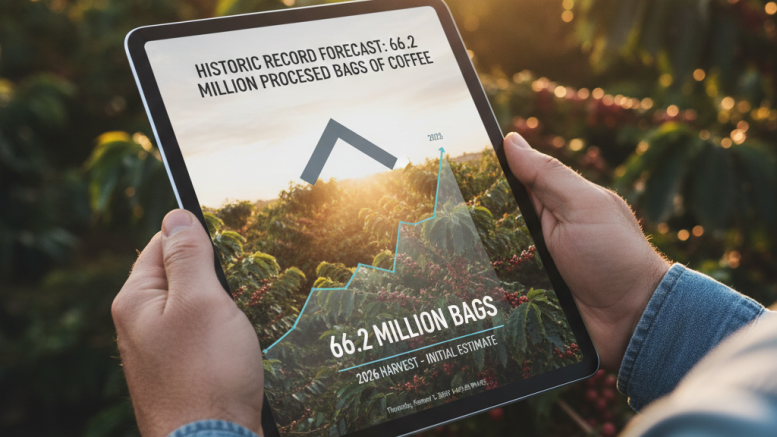
Coffee Harvest Projects a Historic Record of 66.2 Million Processed Bags

In January alone, Senasa blocked the entry of over 17 tonnes of ag products at the border between Argentina and Brazil. The seizure of meats, cold cuts and fresh produce occurred due to a lack of sanitary documentation and non-compliance with transport requirements, resulting in the denaturation of the items to prevent risks to human health and to protect Argentina’s phytosanitary status. (Senasa)
The National Institute of Agricultural Technology San Pedro has launched three new peach cultivars, Tehuelche INTA, Chamamé INTA and Rosalinda INTA. This launch reinforces INTA’s leading role in Argentine fruit growing, where 80% of the varieties cultivated in northeastern Buenos Aires already originate from its research programs—now aiming to renew commercial orchards with materials that feature a strong national identity and high market performance. (INTA)

The tropicalization of canola has established the crop as a robust strategic alternative for the winter crop in the Cerrado, driven by Embrapa Agroenergy advancements that integrate adapted genetics, water management and sustainability. With yields reaching up to 3,800 kg/ha and short-cycle strains (95 days), the crop offers climate resilience and high oil profitability, which is essential for the biofuel and food industries. The combination of tropical seeds with the use of bio-inputs allows canola to not only diversify crop succession systems but also reduce chemical dependency, positioning Brazil as a major player in sustainable vegetable oil production. (Embrapa)
The first 2026 meeting of the Goiás State Development Council approved US$ 6.65 million in funds from the Central-West Constitutional Financing Fund (FCO Rural) for 23 project proposals (letters of intent) dedicated to the agriculture. The approved projects benefit small to medium-sized farmers, covering everything from machinery purchases to irrigation systems and soil correction. Under the technical coordination of the State Secretariat of Agriculture, Livestock and Supply (Seapa), this investment reinforces the strategic role of the FCO in the structural and economic development of the state. (Seapa)
The tobacco sector solidified its strength in the State of Rio Grande do Sul economy in 2025 by recording an 11.2% growth in exports, totaling US$ 3.04 billion in revenue. While the state’s manufacturing industry grew by 4.2% overall, the production of tobacco products jumped an impressive 45.3%, becoming the highest-growth item in the period. These figures reinforce the state’s global leadership in the sector and its strategic importance to the trade balance, representing an increasingly significant share of the total foreign sales of the Rio Grande do Sul industry. (SindiTabaco)
The Brazilian government has concluded negotiations with Turkey to export Brazilian nuts. The initiative strengthens the economy of traditional communities and the conservation of the “standing forest” by introducing a sustainable product into a market that already imported US$ 3.2 billion from Brazilian agribusiness in 2025. (Ministry of Foreign Affairs)
In February 2026, the Coamo cooperative began operations at two new grain receiving units in the State of Mato Grosso do Sul. With an investment exceeding US$ 36.3 million, the facilities feature state-of-the-art technology, totaling a static capacity of 87.2 thousand tonnes. This investment aims to optimize logistics and bring services closer to cooperative members, strengthening competitiveness and regional crop outflow during a strategic period for the state’s agricultural production. (Coamo)
The first estimate for the 2026 coffee harvest projects a historic record of 66.2 million processed bags, a 17.1% jump driven by the “on-year” biennial cycle, favorable weather and management technologies. This growth is led by Arabica (44.1 million bags) and Conilon (22.1 million bags). In the international market, despite the record production, prices are expected to remain high due to rising global consumption—particularly in Asia—and world stocks hitting their lowest levels in 25 years. (Conab)
State of Mato Grosso do Sul is seeking to resolve a bureaucratic impasse that hinders access to rural credit for owners of Private Natural Heritage Reserves (RPPNs), which currently preserve over 153 thousand hectares in the state. Representatives from the State Secretariat for Environment, Development, Science, Technology and Innovation and Banco do Brasil discussed how misinterpretations of banking regulations end up penalizing farmers who opt for voluntary conservation. As a follow-up, Banco do Brasil committed to adjusting its analysis systems and creating a specialized registry to cross-reference agency data, ensuring environmental commitment becomes a facilitator rather than an obstacle to production financing. (Imasul)
New rules from the Ministry of Agriculture and Livestock (Mapa) went into effect on February 4th, 2026, regarding the transport of agricultural products in international luggage, aiming to shield Brazil against exotic pests and diseases. (Mapa, No. 872 from 12/12/2025)
Emater of the State of Goiás and the municipality of Goianésia distributed 40 thousand coffee seedlings to 14 farmers, aiming to revitalize coffee farming in the region and diversify the rural economy, which is traditionally focused on livestock. With specialized technical support and a focus on the growing demand from the Asian market, the project seeks to debunk historical climate limitations and establish Goiás on the national production map, with a planned expansion to 100 thousand seedlings next year. (Emater, Goianésia City Hall)
Soybean prices ended January on a downward trend, pressured by expectations of a record in supply, low domestic demand and the appreciation of the local currency (real), which reduced competitiveness against the U.S. grains. While the national harvest is progressing at a faster pace than the previous season, farmers in the South remain on alert due to low soil moisture levels, awaiting forecasted rains in the coming days to ensure the development of late-planted crops. (Cepea)
Bangladesh received the first shipment of Brazilian green coffee to supply the country’s growing coffee shop sector. The initiative, monitored by agricultural attaché Silvio Testasecca, aims to expand the consumption of coffee beans in a market dominated by soluble coffee, taking advantage of competitive tariffs that put the Brazilian product on equal footing with traditional exporters. This movement consolidates coffee as a new strategic item in the trade agenda between the nations, which already moved more than US$ 2.7 billion in Brazilian agricultural products last year. (Mapa)


Researchers from the National Institute for Agricultural Research (INIA) Quilamapu have launched a strategic rescue of native microorganisms in the area to be flooded by the future Zapallar reservoir. The project aims to collect fungi and bacteria adapted to extreme climatic conditions for long-term conservation at the Microbial Genetic Resources Bank, under the protocols of the Budapest Treaty. The initiative also focuses on the development of biotechnological bio-inputs for agriculture, such as growth promoters and biopesticides. (INIA)
The Minister of Agriculture, Ignacia Fernández, confirmed the total eradication of the fruit fly in the Valparaíso region following the control of four outbreaks in 2025. The strategy focuses on strengthening border surveillance by the Agricultural and Livestock Service (SAG) and advancing a bill to criminalize the illegal import of ag products, a measure considered urgent to protect the country’s phytosanitary status and export competitiveness. (SAG)

The rural sector closed 2025 with historic results, reaching a record 4.8 million employed people and reducing the rural unemployment rate to 6.7%, the lowest level in seven years. Driven by agrarian reform policies and incentives for agricultural production, the sector solidified its position as a national economic engine by generating 103,000 new jobs in a single year, totaling 3.4 million direct workers in farming and fishing activities. (Ministry of Agriculture)

The project Strengthening of the Integrated Knowledge Management System for Sustainable Food Security in Cuba (CONSAS), a partnership between the Ministry of Agriculture, FAO and the EU is introducing new varieties of tomato, pepper, chard and cucumber to boost productivity and food security in the country. The initiative integrates biotechnological innovation and scientific infrastructure to overcome climate challenges and input shortages, using varieties selected by local researchers and promoting sustainable management through national biopesticides. (FAO; Ministry of Agriculture)


Banana exports closed 2025 with a record 377 million boxes, a 3.5% growth that reaffirms the country’s global leadership in the sector. The EU and Russia remain the top destinations, absorbing more than 50% of shipments, while markets like China and Turkey showed significant spikes of 16% and 30%, respectively. Despite logistical challenges and high operational costs, this performance consolidates the fruit as a central pillar of the Ecuadorian economy for 2026. (Fresh Fruit)
Secretary Julio Berdegué led a strategic dialogue with wine and vegetal growers in Baja California to address challenges such as water scarcity, hydraulic infrastructure and bureaucratic simplification. The region’s importance is highlighted by its responsibility for 70% of wine production, focusing on the modernization of irrigation districts and the strengthening of plant health. The government seeks to transform the sector into a more competitive and sustainable model by removing administrative barriers and promoting technology transfer to ensure that the local agro-industry remains one of the country’s primary economic engines. (Federal Government)
The government has launched a strategic operation to halt the spread of the New World Screwworm (GBG) in the regions of Tamaulipas, Veracruz and San Luis Potosí. The measure, which includes preventive animal treatment and rigorous livestock movement control, is aligned with a binational strategy with the U.S. to prioritize the release of sterile flies at the pest’s advancing fronts. The operation seeks to protect the national herd and prevent progression into new ranching areas. (Ministry of Agriculture)
The USDA has announced a preventive reinforcement of the buffer zone along the US to Mexico border to block the spread of the New World screwworm (NWS), relocating aircraft and dispersing 100 million sterile flies per week across a polygon covering the Mexican state of Tamaulipas and Texas. Although the northernmost active case in Mexico is still 320 kilometers from the border, the strategic release of sterile males aims to disrupt the pest’s reproductive cycle as it proactively spreads through Mexican territory. This initiative combines the sterile insect technique with rigorous surveillance and import protocols to mitigate the risk of infestation reaching US livestock amid the advance observed south of the border. (USDA)

The Uruguay–China Trade and Investment Forum consolidated China as the main destination of the Uruguayan agribusiness, highlighting the grain sector as the Chinese market absorbed 86% of the country’s soybean exports in 2025. The official mission focused on strengthening the commodity export agenda, with an emphasis on soybeans, pulp and beef and attracting investments for agro-industry and biotechnology. (Uruguay XXI – Investment, Export, and Country Brand Promotion)

READ MORE:
Total Soybean Harvest Area Has Reached 24.97%