
“Atrazine is an active ingredient that has been widely studied and used for decades in Brazilian agriculture…”
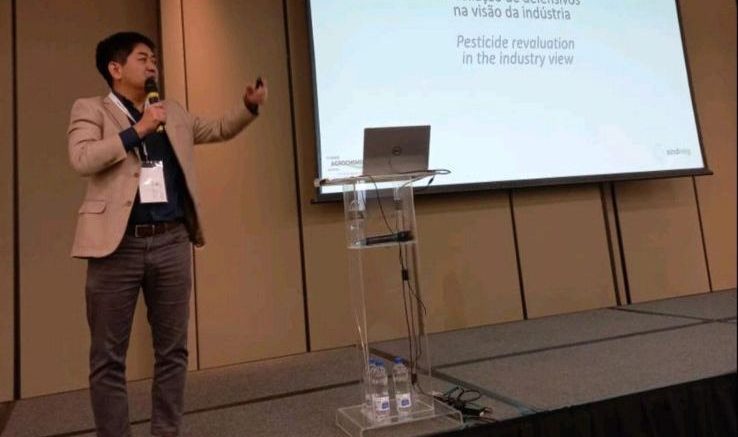
Fábio Kagi is Regulatory Affairs Manager at the Sindiveg (National Union of the Plant Protection Products Industry in Brazil). He holds a degree in Agronomy from Unesp and an MBA from FGV.
AgriBrasilis – Is the use of atrazine safe for the environment?
Fábio Kagi – Atrazine is an active ingredient that has been widely studied and used for decades in Brazilian agriculture, with registration granted by the competent regulatory authorities (ANVISA, IBAMA and the Ministry of Agriculture and Livestock – MAPA). When applied in accordance with the technical recommendations approved on the product label, respecting doses, indicated crops and good agricultural practices, there are no contraindications.
It is worth noting that the Brazilian regulatory system is robust and based on scientific criteria, assessing risks to human health, the environment and agronomic efficacy before any authorization is granted, as is the case with atrazine.
AgriBrasilis – What justifies the two Public Civil Actions (Dourados River Basin and Upper Paraguay Basin) brought by the Federal Public Prosecutor’s Office (MPF) against the use of this molecule?
Fábio Kagi – The Public Civil Actions proposed by the Federal Public Prosecutor’s Office are based on concerns related to potential environmental impacts in local contexts, especially with regard to the protection of water resources. These are initiatives that seek to assess specific regional situations.
Sindiveg emphasizes that any questions should be analyzed in light of consistent technical evidence and within the existing regulatory framework, avoiding generalizations that disregard the body of scientific studies already available on the molecule.
AgriBrasilis – According to IBAMA, atrazine will undergo an environmental re-evaluation process. What are the possible consequences?
Fábio Kagi – Risk re-evaluation is an instrument provided for under Brazilian legislation and is part of the continuous process of regulatory improvement. This procedure may result in the maintenance of the registration, the updating of mitigation measures and use restrictions, or, in more restrictive scenarios, changes to application conditions.
Sindiveg believes that this process should be conducted in a technical and transparent manner, based on scientific criteria and in compliance with Brazilian legislation, ensuring regulatory predictability for farmers and the continuity of important tools for agricultural management.
AgriBrasilis – The use of atrazine is permitted in Brazil but banned in the European Union. Why?
Fábio Kagi – Regulatory decisions vary among countries and economic blocs because they reflect different agricultural, climatic and environmental realities, as well as distinct risk assessment criteria. In the case of the European Union, the precautionary principle prevails, whereas Brazil adopts a risk-based approach, considering exposure, management and conditions of use. In other words, the difference in regulatory status does not, in itself, imply a lack of safety, but rather the adoption of different regulatory models.
AgriBrasilis – Could this type of legal action occur more frequently in other regions?
Fábio Kagi – The judicialization of issues related to agriculture and the environment has intensified in recent years, in line with the growing public debate on sustainability and food production. This scenario underscores the importance of institutional dialogue, strengthening technical communication and respecting official regulatory authorities.
Sindiveg reiterates the importance of ensuring that discussions of this nature are conducted based on science, legal certainty and recognition of the relevance of crop protection products to productivity, the competitiveness of Brazilian agribusiness and food security.
Read more: